

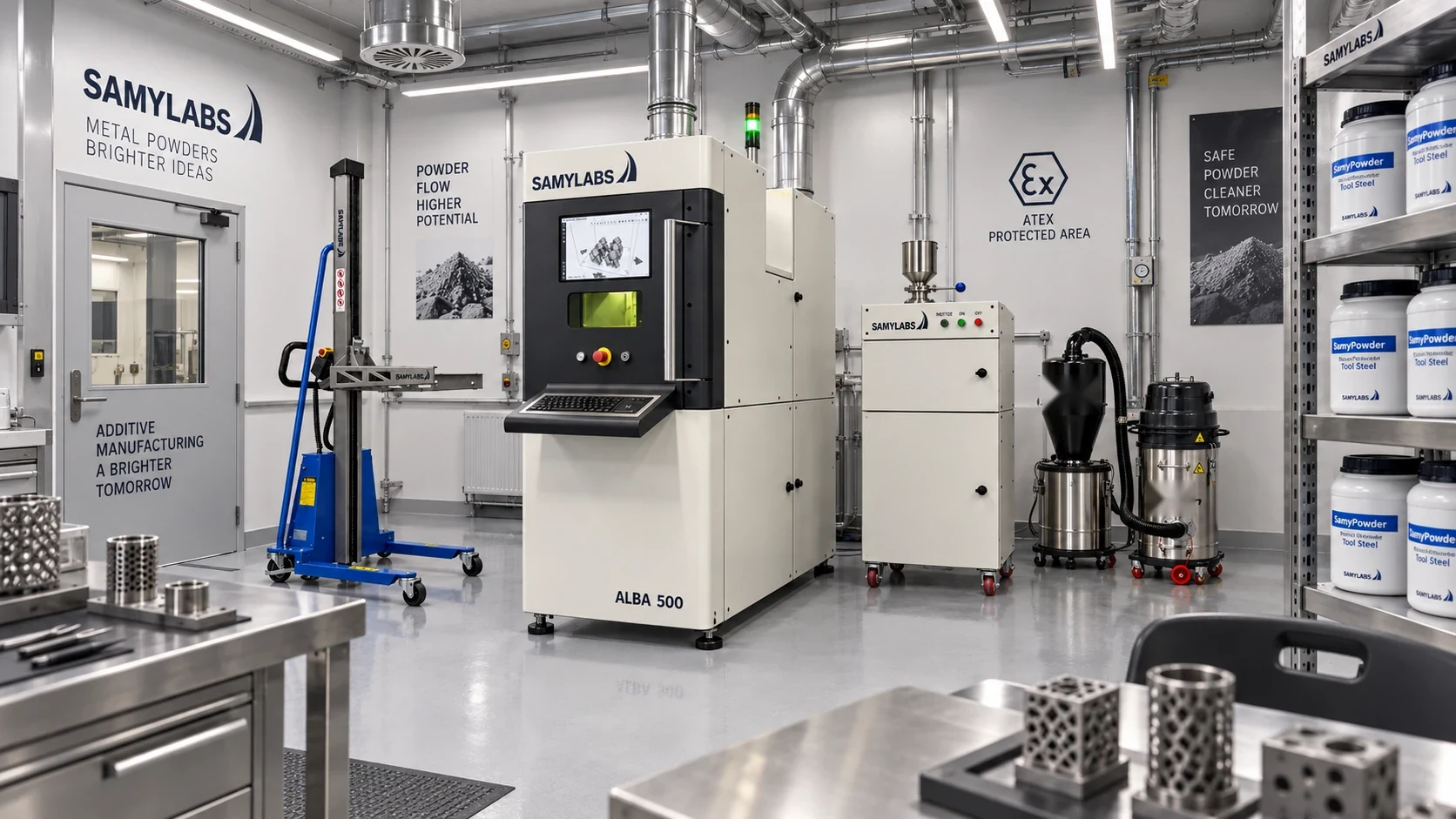
What does ATEX mean in a metal 3D printing facility?
metal powder measuring fifteen to forty-five microns has an enormous exposed surface area relative to its mass. This, which makes it useful for laser melting, is also what makes it dangerous: in titanium and aluminium, this powder can form an explosive atmosphere and can ignite upon contact with air. The ATEX directive is the European framework that regulates working under these conditions, and it affects much more than just the machine.
This article is not a substitute for a prevention plan. It's simply the information you need before you start creating one.
What exactly is risk?
It's not that the powder explodes on its own. It takes five things at once, and prevention work consists of breaking at least one:
- Fuel: the metal powder.
- Oxidizer: oxygen in the air.
- Dispersion: dust suspended in the air, forming a cloud.
- Confinement: an enclosure where this cloud accumulates.
- Ignition source: a spark, a hot surface, static electricity.
The most dangerous combination isn't what people imagine. It's not the machine itself—inside there's argon and the oxygen is below 1,000 parts per million—but rather the handling of the powder outside of it: transferring, sifting, vacuuming, and cleaning. That's where the air, movement, and clouds are.
And there is a second specific risk associated with reactive metals: finely divided titanium powder can burn in air without any further fuel, and this combustion cannot be extinguished with water or conventional fire extinguishers. Water on burning metal only makes things worse.
What ATEX requires, in practice
The directive translates into four obligations that are noticeable on a daily basis:
| Obligation | What it means in the facility |
|---|---|
| Classify the zones | Define where an explosive atmosphere may be present and how frequently. Around screening and transfer, almost always. |
| Equipment suitable for the zone | Equipment operating in a classified zone must be certified for that zone. A shop floor vacuum cleaner is not suitable. |
| Explosion protection document | The document that includes the assessment, classification, and measures. It is mandatory and is the first thing an inspection will request. |
| Staff training | Those handling the powder must know why they are doing what they are doing, not just follow a procedure. |
Which teams are affected
This is the part that throws off someone who has only quoted the price of the machine:
- The screening machine or sieve. This is where the powder is moved and aerated the most. It must be suitable for classified areas and, for reactive materials, be able to be inertized with argon or nitrogen to operate without oxygen inside.
- The vacuum cleaner. A standard industrial vacuum cleaner is not sufficient: one certified for combustible metal powders is required, with wet separation or the system appropriate for the material.
- Storage. Closed, airtight containers, labeled by alloy and batch, and in the case of titanium, with a controlled atmosphere.
- The transfer station. The moment of transferring powder from one container to another is the point of greatest exposure.
- Grounding everything. Static electricity is the most common source of ignition and the easiest to forget. Everything metallic that comes into contact with powder must be grounded.
What really prevents incidents
In order of effectiveness, and none of the first three cost money:
Work in a closed circuit. The less powder in the air, the lower the risk. An inertable screen with sealed loading and unloading eliminates most of the problem by design, not by procedure.
Never sweep. Sweeping stirs up powder and creates the cloud we're trying to avoid. Vacuum with the appropriate equipment, or collect wet if the material allows it.
Systematic grounding. Person included: conductive footwear and flooring in the handling area.
Separate by material. Do not mix titanium and steel in the same consumables, nor share filters or vacuum cleaners between alloys. Besides being safe, it's about quality: cross-contamination ruins a batch.
A specific emergency plan. With a Class D metal fire extinguisher, dry sand available, and everyone knowing that water is not to be used. It's a ten-minute conversation that only needs to be done once.
Questions to ask before buying
- Is this equipment certified for the area where I will be installing it, and under what category?
- Can the interior be inerted, and what is the gas consumption?
- How are the powder and sieve loaded and unloaded without opening the circuit?
- How is it cleaned, and what is required to change the alloy?
- What training is included with the installation, and for how many people?
The third factor is what most differentiates one team from another. A sieving process that requires opening and hitting the sieve to unclog it is a sieving process that generates a cloud of dust every time.
How do we solve it?
The GARBI sieve is designed precisely for this scenario: its interior can be inerted with argon or nitrogen, it's designed for installations with ATEX requirements, and it combines vibration and ultrasound precisely to avoid having to strike the screen. That detail, which may seem minor, is the difference between clean screening and one that raises dust with every cycle.
We don't sell prevention plans or zone classifications: that's done by a prevention technician on-site. What we can tell you is what our team requires and doesn't require, so the plan takes that into account from the start.
—
Where does this powder come from and why is its size what it is? Find out in how metal powder is manufactured. Which alloys are reactive and which don't present this problem? Find out in which materials can be printed in metal. And what does it cost to set up the entire installation, including this part? Find out in the real CAPEX of entering the additive manufacturing industry.
Materials30 March 2023
Converting waste into metal powder: the project supported by the CDTI’s MISIONES program
Compañía23 March 2023
Public funding programmes
Business16 September 2026