First and only Spanish manufacturer of LPBF machines

Additive manufacturing in metal without technological dependence.

We design and manufacture LPBF metal 3D printers where the hardware, electronics, firmware, slicing software, and process parameters are all ours. No royalties. No licensing fees. No black boxes you can't open.

2016Founded in Bizkaia
100 %Technology developed in-house
7 countriesMachines producing every day
0Royalties and licenses per part
230 VA standard electrical outlet and an argon cylinder
CE · ATEXMachine certifications
01 SamyQuote · quote calculator

Do you know what price to charge your client for this part?

We do, because we develop the parameters used to manufacture it. And from now on, you can too, in less than a minute and without calling anyone.

You upload the geometry, choose the alloy and finish. Our printing software finds the best orientation, calculates supports, and determines the paths. It then provides you with the printing time, the number of parts per build plate, and the cost per unit.

  • The cost per part, with its breakdown
  • Full breakdown, so you can see where every euro comes from
  • Designed for you to quote parts to your own customers

Estimates are based on assumptions that are always kept in mind. They are for guidance only: they are not an offer and do not replace process validation.

What you see is the actual calculation, in the same order: geometry, slicing, build plate layout, and cost estimate. The examples are illustrative and are pending engineering validation.
02 Products

Two platforms, the equipment that surrounds them, and the software that powers them.

Both machines run the same software, the same electronics, and the same processing technology. Switching from one to the other doesn't require you to retrain your workflow.

And all around, everything needed for real production: screening, reduced volume for testing, aspiration, handling, and the powder itself. Almost all of it is ours—the aspiration unit is a Delfin model that we distribute—and everything is compatible with each other.

SAMYLABS ALBA 300 Metal 3D Printer

ALBA 300

The benchmark in its category

Compact enough for use in a shop floor, laboratory, or office. It fits through a standard doorway, operates on single-phase household current, and consumes about the same amount of energy as an electric iron.

Laser power
300 W
Wavelength
1080 nm
Print volume
Ø160 × 200 / Ø200 × 250 mm
Full technical specifications 10 more specifications Expand
Layer thickness
20–100 µm
Spot diameter
< 100 µm
Scan speed
2 m/s
Filtration unit
Simple
Shielding gas
Argon or nitrogen
Oxygen in chamber
< 1000 ppm
Power supply
230 V · 50–60 Hz · 2.7 kW
Dimensions
730 × 1550 × 1850 mm
Weight, excluding powder
800 kg
Certifications
CE and ATEX
Full details →
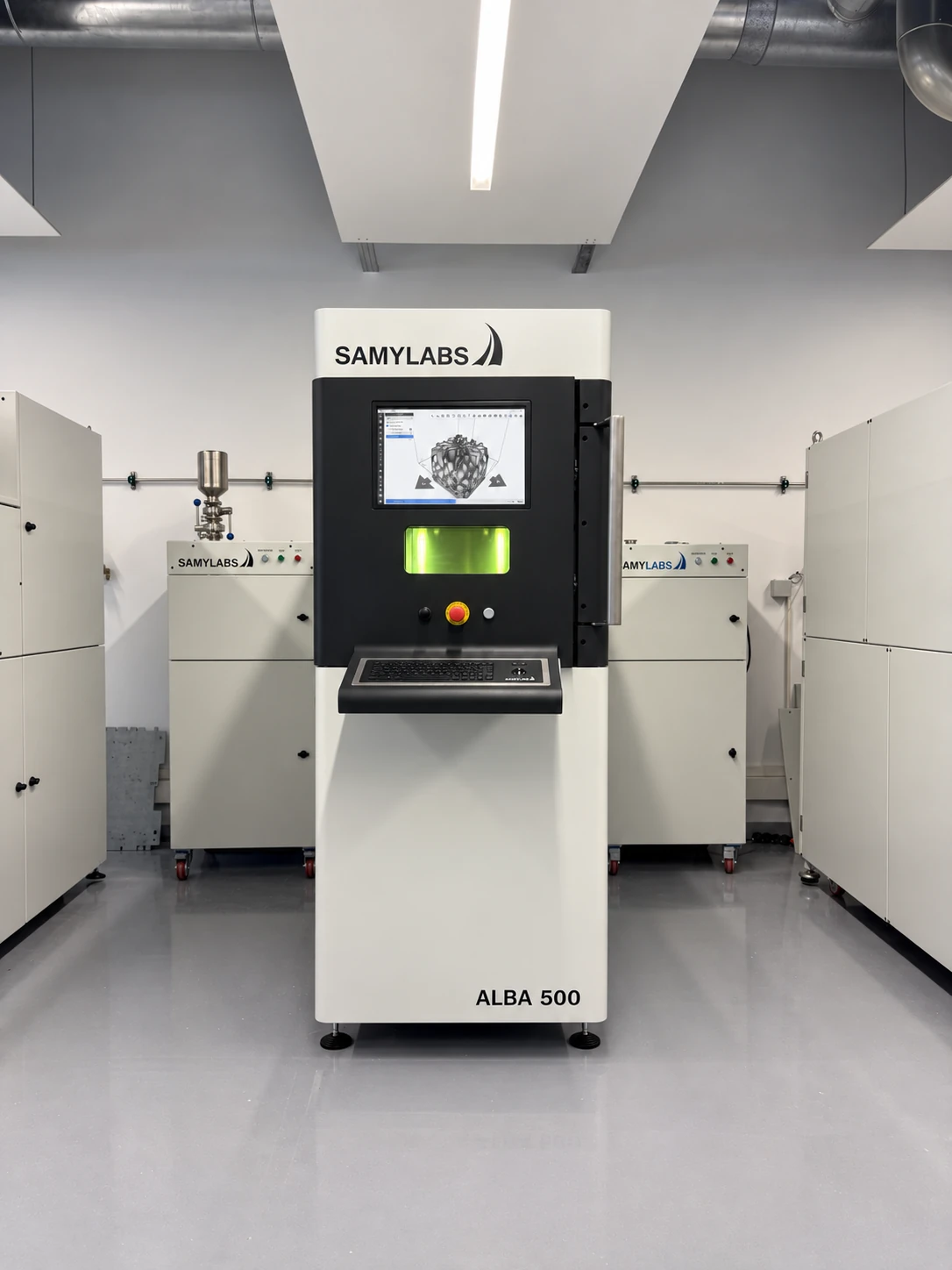
SAMYLABS ALBA 500 metal 3D printer installed in a customer's room

ALBA 500

Unlimited production

Larger prints, more power, and significantly more prints per build plate. The dual filtration with bypass allows you to change the filter without stopping the print, which in long builds is the difference between finishing them and losing them.

Laser power
500 W
Wavelength
1080 nm
Print volume
250 × 250 × 300 mm
Full technical specifications 10 more specifications Expand
Layer thickness
20–100 µm
Spot diameter
< 100 µm
Scan speed
2 m/s
Filtration unit
Double, continuous: the filter is changed without stopping printing
Shielding gas
Argon or nitrogen
Oxygen in chamber
300 ppm
Power supply
230 V · 50–60 Hz · 2.7 kW
Dimensions
745 × 1950 × 1940 mm
Weight, excluding powder
800 kg
Certifications
CE and ATEX
Full details →
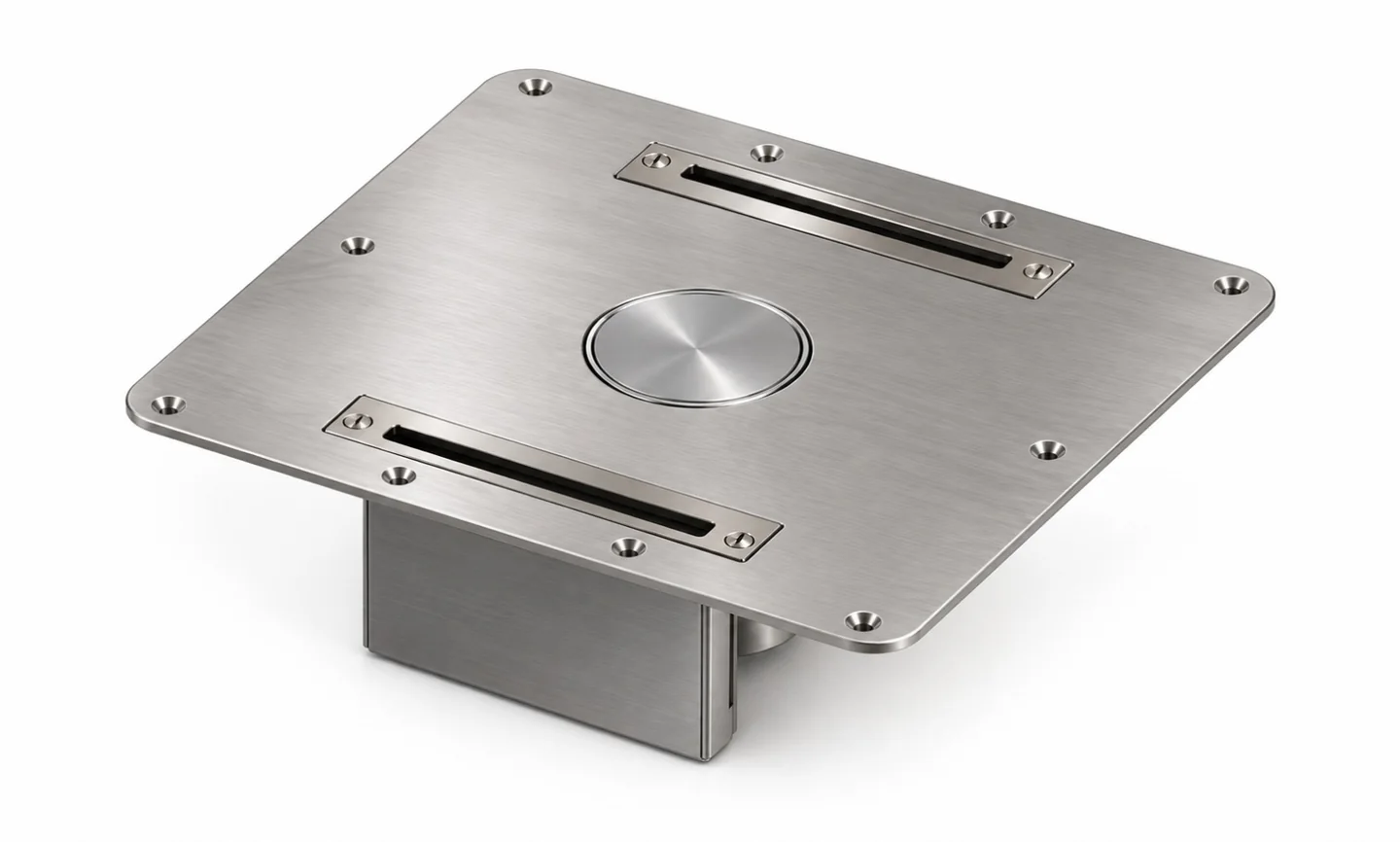
Interior of the chamber of an ALBA 500 with the reduced volume SamyFlex module in cutting: the reduced circular platform with a part being manufactured on it

SamyFlex

Reduced volume

This module is installed inside the chamber and replaces the working area with a smaller one. It allows for testing materials and parameterization using a fraction of the powder, and for starting up without immobilizing the entire load.

Compatible with
ALBA 500
Work area
Circular, up to 150 mm in diameter
How it works →
SAMYLABS Garbi metal powder screener, in closed circuit

Samylabs Garbi

Closed-circuit screening

Closed-circuit ultrasonic metal powder sieving machine, ATEX certified, with an interior that can be inerted with argon or nitrogen. Powder is recovered without the operator inhaling any of it.

Sieving throughput
1 kg per minute
Dimensions
632 × 1588 × 570 mm
Maximum weight
220 kg
Full technical specifications 4 more specifications Expand
Power supply
230 V 50–60 Hz 0.25 kW
Gas
Argon or nitrogen
Gas flow rate
10 l/min
Oxygen in chamber
< 1000 ppm
Full details →
Metal powder vacuum cleaner with cyclone separator

Aspirator

Safe cleaning of metal powder

Dedicated extraction system for fine metal powder, which is precisely what a shop floor vacuum cleaner cannot do. Essential in any facility working with reactive alloys.

For
Fine metal powder
Use
Build chamber and surrounding area cleaning
Models
MTL 301 Z22 with cyclone · MTL 202 DS EX with ATEX-rated for reactive powders
Full technical specifications 1 more specifications Expand
Technical specifications
On the Delfin website, the manufacturer
Samylifter, tub lift and platform from SAMYLABS

Samylifter

Tank elevator

Lift for handling the tank and platform without manual lifting. It's the accessory that makes changing jobs a one-person operation.

For
Manipulation of the plates and build jobs
Load capacity
200 kg
Height
From 130 to 2000 mm
Full technical specifications 3 more specifications Expand
Dimensions
920 × 605 × 2305 mm
Weight
80 kg
Battery
24 V · 20 Ah
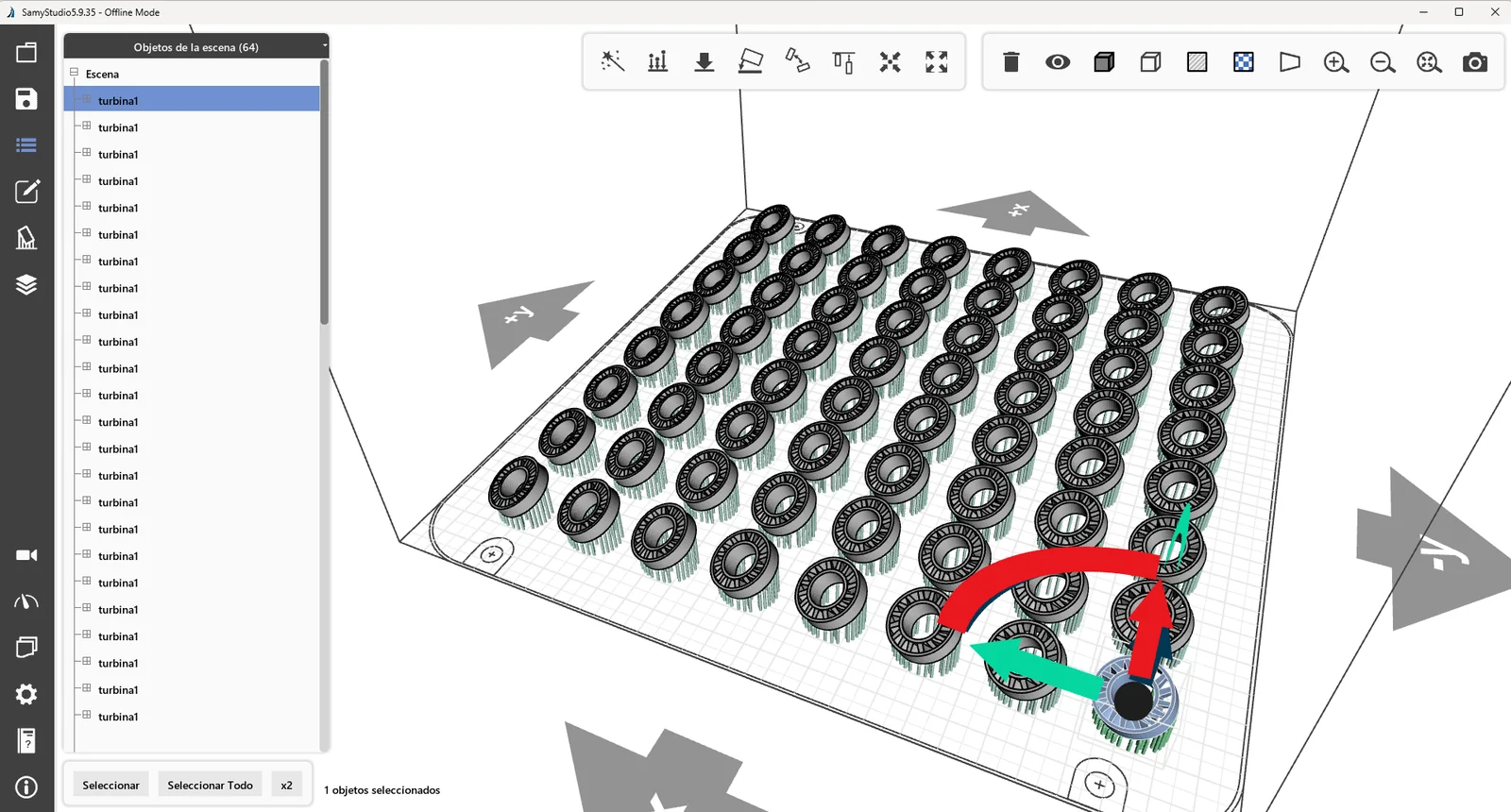
SamyStudio 5.9: a build plate with 64 identical parts arranged in a matrix, each with its calculated supports

SamyStudio

The machine's software

Slicing, supports, parameterization, and process control all in one program, written in-house along with the machine. It runs directly on the ALBA and leaves all parameters open, allowing you to save your own material parameter sets.

Version
5.9
Functions
Slicing, supports, simulation, parameterization and control
Parameters
Open, with their own material parameter sets
Full technical specifications 2 more specifications Expand
Licenses
No royalties or limit on positions
With the machine
Included in ALBA 300 and ALBA 500
See SamyStudio →
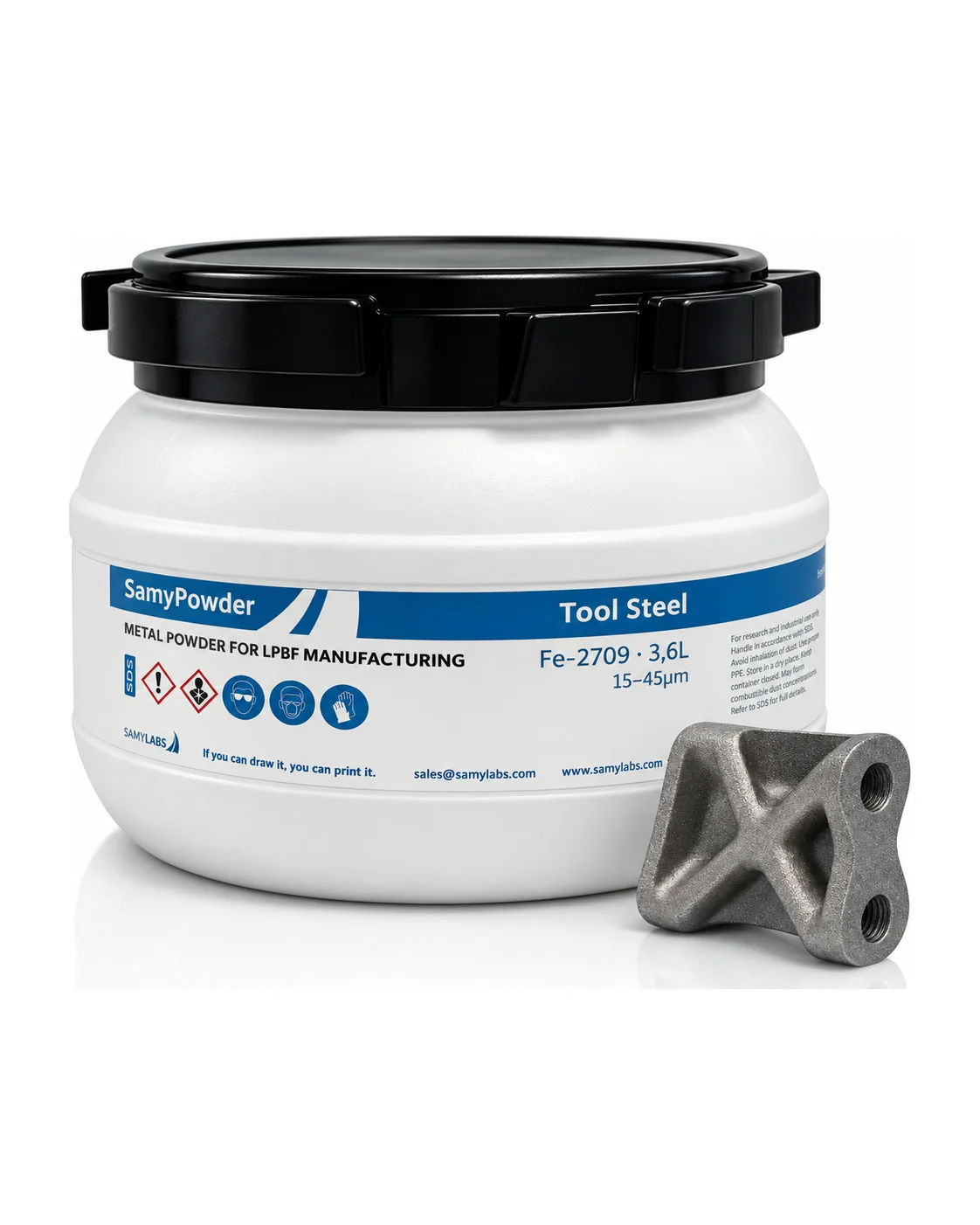
A container of SamyPowder metal powder next to a part made with it.

SamyPowder

The consumable, with its parameter set made

Seven inert gas atomized alloys. Each batch comes with its batch certificate, particle size distribution, and traceability number—and if the machine is an ALBA, with the process parameter set already qualified, so there's no need to parameterize from scratch.

Alloys
316L, Fe2709, Ni718, Ti-6Al-4V, AlSi10Mg, CoCr and GRCop-42
Particle size distribution
15-45 µm · 20-63 µm in aluminium
Formats
3.6 L and 25 kg containers, pallet, and 1 kg sample for qualification
Full technical specifications 2 more specifications Expand
Traceability
Batch certificate and batch number on each container
Without ties
The machine accepts any powder you need; ours arrives ready-made.
View the catalog →
A316LStainless steel
C300Tool steel
IN718Inconel
AlSi10MgAluminium
Ti6Al4VTitanium
CoCrCobalt chromium

Open parameterization means you're not tied to a single powder supplier. You can develop and save your own material parameter sets and take them with you.

03 AdditiveDelivery · new

What if you don't want to buy the machine, just the part?

Upload it and we'll manufacture it for you. It's made in a shop floor within our network, using the same machine, the same rolling mill, and the same parameters we use here, so the part comes out exactly the same no matter where it's made.

And the price too: nobody negotiates it, the price calculator determines it. You choose when you want it.

  1. 01

    You upload the 3D

    From the quote tool, with the estimate already displayed.

    You
  2. 02

    Arrive at our headquarters

    One single point of entry, and your file stays here.

    Samylabs
  3. 03

    It is analyzed

    Viability, alloy, orientation and post-processing.

    Samylabs
  4. 04

    The price is calculated

    Cost of the quote tool, plus margin, plus shipping. No bid.

    SamyQuote
  5. 05

    Looking for a space

    Shop floors compete on availability, not price.

    AdditiveDelivery
  6. 06

    You choose the delivery date

    You see the dates with their price and start the machine.

    You
  7. 07

    You receive the part

    Within the deadline, with its manufacturing report.

    You

While the network is being launched, some parts are manufactured on our own machines. The price quote always specifies where your part comes from.

04 The awkward question

A forty-hour build begins on a Friday afternoon.

Nobody will be there. On Saturday morning, the part is either there or it isn't. And if it isn't, you haven't just lost the part: you've lost the powder, the argon, the machine slot, and the date you gave your client.

These are the five things that truly concern those who sign a purchase agreement. And what we've built to address each one.

What keeps you up at night

  • Will the part be ready on Monday, or will I have lost both my weekend and the part?
  • How much will I discard, and what does it depend on?
  • Will I be able to repeat this exact part in a year?
  • What evidence do I show to my client, my auditor, or whoever has to certify it?
  • Who do I depend on if I need a material tomorrow that isn't in the catalog?

What we have done about it

  • The machine monitors each layer and automatically corrects the four flaws that ruin a build
  • It detects and compensates for regrowth, the most frequent and most expensive failure in the LPBF process.
  • The parameters for each job are saved, exported, and are yours, not ours.
  • Each build generates its own process record, which can be exported for the quality file.
  • The parameterization is open and we wrote the software ourselves: if something needs to be developed, it will be developed.
05 Closed-loop process control

Most LPBF machines operate in open loop. We are closing ours.

In an open-loop machine, the slicer writes a file, the drivers execute it, and for the next twenty hours, all you can do is hope nothing goes wrong. Our slicing and control software commands the machine in real time, and sensors monitor the actual progress of the print.

That's where the story ends today, and the work begins: closing the loop means that the reading goes back into the process and corrects itself. These are the four steps, and where each person is at.

In development This is not a feature of the machine we deliver today: it is the line of work we are on. We say so because that is where our effort goes, and because in this sector it tends to be announced as solved with great cheer. What the ALBA does today is measure and record; correcting by itself will come when it is proven, not before. And when it comes, it will act layer to layer, not within the layer: it does not close the loop on melt pool geometry —real-time control that no commercial LPBF machine we know of offers today— nor does it replace tomographic inspection. What AI really brings to additive manufacturing, what is under development and what no commercial machine does today: we keep it in three separate piles.

POWDER BED LAYER 1,284 · IMAGE CAPTURED SUPER-ELEVATION CONTOUR EXTRACTED NO ENERGY LAYER 1,285
01

Monitor It works today

A 2D build chamber takes an image of the powder bed after each coating. Sensors redundantly read oxygen, chamber pressure and temperature, laser system and optical path temperature, filter clogging by differential pressure, and powder level using millimeter-wave radar.

02

Detect In development

A deep learning model trained on intentionally generated defective prints classifies what it sees. A regrowth appears as a silvery area protruding above the powder: the most frequent and damaging defect in the LPBF process.

03

Analyze In development

A Sobel filter extracts the contour paths that enclose the affected area, in the machine's own coordinate system. It's not an alert: it's a geometry.

04

Correct In development

These contours are subtracted from the path of the next layer. No energy is supplied to that area, the overgrowth stops, and build continues. Once compensated, the software returns to normal operation.

FailedHow it manifestsCorrection we are working on
Insufficient powder coverageA bald spot in bed after dispensingThe contribution time is increased
DebrisDirt on the print area: the gas blade has stopped sweeping effectivelyThe power of the recirculation pump is increased, cross-referencing the data with the differential pressure sensor of the filter.
StripesThe dispenser gasket is torn. This is a precursor to a brush blockage and print failure.The affected part is cancelled to save the rest of the build, or the operator is notified.
Re-enlargementsSilver areas above the powder bed after dispensingIts outline is extracted and subtracted from the next layer
06 SamyStudio 5.9

The slicer is not a separate product. It is the machine.

SamyStudio is our in-house developed slicing and control engine. It runs directly on the machine, allowing the operator to work without a workstation or prepare jobs remotely from the technical office via network or USB.

  • All process parameters are open, with material presets as a starting point and not as a cage.
  • Adjustable laser power and scanning speed while the machine prints
  • Variable layer thickness with automatic geometry detection, compensating for energy in real time
  • Only the contour paths are stored; the fill is generated on the fly, which keeps the files lightweight.
  • Real-time telemetry of oxygen, gas flow rate, and pressure
  • Exporting print logs, identifying jobs and profiles, local storage
  • Compiled and encrypted. Royalty-free, unlimited licenses, no cloud dependency
SamyStudio 5.9: a build plate with 64 identical parts arranged in a matrix, each with its calculated supports
SamyStudio 5.9 — a build plate with 64 parts placed and supported.
07 SamyStudio, in progress

Seeing it in action explains more than any instruction sheet.

A complete 42-part print job from start to finish: loading, generating supports, distributing them on the build plate, slicing, and simulating the printing time. No cuts and no voiceover telling you how innovative we are.

Served from this website, not from YouTube: it doesn't download until you click on it and there are no third parties watching who views it.
  • Fill the build plateOne part becomes 42 with "distribute in area" and a 7 mm gap between parts. There's no need to place them manually one by one.
  • Supports by number, not by eye.Density, base diameter, body diameter, contact point and separation are fixed with figures, recalculated and saved.
  • Slice and checkFixed or variable layer thickness, and collision checking on all 42 parts before sending anything to the machine.
  • Time, before printingThe simulation runs through the entire build process and estimates the time it will take. That time is what feeds our quoting tool: the estimate isn't based on a price list, it's based on your part.
08 Evaluate your part

Is LPBF the technology you're looking for?

Four questions. They're the same ones we ask ourselves before proposing anything, because selling a machine to someone who doesn't need it is costly for both of us.

  1. 01

    Does the part fit in the print volume?

    250 × 250 × 300 mm. The closer to the size of a two euro coin, the better the calculation.

  2. 02

    Is it a hard material or a special alloy?

    Stainless steel, Inconel, titanium, cobalt chromium, tool steel.

  3. 03

    Does the traditional process require multiple operations or multiple machines?

    Machining plus welding plus fitting, tooling, molds, assemblies.

  4. 04

    Low or medium production?

    From 1 to 10,000 units per year.

Our reading

Answer all four and we'll tell you what we think, even if the answer is no.

09 Where it pays off

Parts that cannot wait, or that cannot be made in any other way.

These are the sectors ALBA is currently working in. The criterion isn't the sector itself: it's that the part has a geometry that can't be machined, a lead time that doesn't allow for tooling, or a production run that's too short to justify the cost.

Illustration of the aeronautical and defense sector: supports lightened by topological optimization, impellers and lattice structures manufactured by metal 3D printing

Aeronautics and defense

Functional critical spare parts with adapted properties, manufactured locally in 48 hours, even when there is no original drawing or the supplier is no longer available.

Illustration of the energy sector: turbine impellers, heat exchangers with internal channels and lattice supports manufactured by metal 3D printing

Energy and aerospace

Turbine impellers and blades, monolithic heat exchangers with internal channels, and supports lightened through topological optimization. Components that eliminate joints and leakage paths.

Mold and tooling illustration: inserts with conformal cooling channels and mold inserts manufactured by metal 3D printing

Mold, tooling and Oil & Gas

Conformal cooled inserts —the channel follows the shape of the part, not the drill bit—, stamping seals, cutting tools, punches, and complete small molds.

Illustration of the automotive and railway sector: lightweight supports, manifolds and ducts manufactured by metal 3D printing

Automotive, rail and shipbuilding

Prototypes, tooling and fixtures, individualized components, forming tools for complex tube geometries and short series of structural parts.

Illustration of the medical and dental sector: implants with porous surfaces, dental structures and prostheses manufactured by metal 3D printing

Medical, dental and jewelry

Implants and prostheses in medical grade titanium and cobalt chromium, dental structures, and jewelry parts where the geometry does not allow for molding.

Illustration of research and education: test specimens, lattice structures, and metal powder samples in an additive manufacturing laboratory

Research and education

Open parameterization transforms ALBA into a platform for developing materials and process strategies, not a sealed appliance. This is how universities and technology centers use it.

The images above are section illustrations, not photographs of our parts. The actual parts, manufactured with an ALBA machine and without any rendering, are in parts.

What's coming

And when the designer is not human.

Additive manufacturing has been losing a fair comparison for fifteen years: a part designed for milling is better manufactured on a milling machine. Flat faces for clamping, straight holes because the drill bit is straight, draft angles. That vocabulary is so ingrained that it's no longer visible.

An optimizer doesn't have that. You give it the available space, the anchors, and the loads, and it returns the material distribution that supports that with the minimum mass. What comes out resembles a bone: ribs that follow the load, gaps where material wasn't needed, sections that change continuously.

And that way can't be done any other way.

It cannot be molded because there is no draft direction. It cannot be machined because there is nowhere for the tool to enter. It cannot be cast without cores, which are themselves impossible. The part that is impossible for all other processes is exactly the one that an LPBF machine manufactures effortlessly.

What will multiply this is not the power of the optimizer—it's been in simulation software for over a decade—but the level of expertise required to use it. The day describing the problem is enough to obtain a reasonable design, we'll be optimizing parts that no one even considers optimizing today. Each one is an application of this technology that isn't currently on any list.

With its fine print, which we also discuss: optimization isn't always profitable, organic doesn't mean manufacturable, and a closed-cell lattice is a dusty part that will never be removed. The whole argument, with its four caveats.

Five steps

And our turn has not yet come.

The short way to explain why this isn't a fad: artificial intelligence doesn't take a leap, it climbs rungs, and each rung changes who can use it. Today we're on the third.

The one that interests us is the fourth. An AI that no longer just carries out what you tell it, but proposes design alternatives and optimises geometries on its own. When that arrives, it will find LPBF applications in parts nobody considers redesigning today — and that is an upturn for this technology, not for this manufacturer.

  1. 2024 Level 1 Chatbots They converse, consult information, and write. Basic assistance.
  2. 2025 Level 2 Reasoners They analyze a complex problem, break it down into steps, and compare alternatives.
  3. 2026 Level 3 Agents They perform real tasks: they use applications, chain actions together, and work with a certain degree of autonomy.
  4. 2027 Level 4 Innovative AI Instead of obeying, propose: design alternatives, optimized geometries, solutions you hadn't asked for.
  5. 2028 Level 5 Organizers They coordinate agents, tools, and simulations: they break down an objective into subtasks and distribute resources.

The timeline is an industry forecast, not a delivery date—and we don't sell AI here. What we do say is what happens when the fourth tier is available to any engineer: parts that aren't worth optimizing today will be optimized, and most of those shapes are only manufactured by powder bed fusion.

The same suspension knuckle, on the left with the conventional design of straight ribs and on the right topologically optimized, with organic ribs that follow the load.
The same part, the same anchor, and the same loads. On the left, designed to be manufactured by a milling machine. On the right, letting the optimizer decide where material is needed.
Example parts

This comes from a dawn.

None of these images are renders. They are parts manufactured with an ALBA 300 or an ALBA 500: geometries that cannot be machined, channels that cannot be drilled, and structures that cannot be cast.

Hover your mouse over any of them to see them more closely.

Set of parts manufactured by metal 3D printing: collector, lattice structure, topologically optimized fork and plates
metal 3D printing Part families Collector, lattice structure, optimized fork, and exchange plates. All from the same machine.
Newly manufactured structural part on the platform, with its lattice supports still in place
Manufacturing supports Fresh from the build chamber With its lattice supports still in place. This is what a part actually looks like before it's separated and cleaned.
Closed turbomachine impeller printed in metal with polished finish
One-part turbomachine Closed impeller Internal blades and housing are a single part. No tools can go in there.
Three turbine impellers of different sizes manufactured by metal 3D printing
Short series in metal Turbines The same geometry in three scales. Changing sizes doesn't require new tooling.
Detail of metal printed parts with internal lattice structure and manufacturing surface
internal lattice structure The close-up detail Lattice, through-holes, and machined surface. The fine finishing comes later, only where the drawing calls for it.
Detail of the thin fins of a heatsink manufactured by metal 3D printing
Cooling and dissipation Finned heatsink Thin fins, very close together, impossible to machine. The heat exchange surface is determined by the heat sink, not the milling cutter.
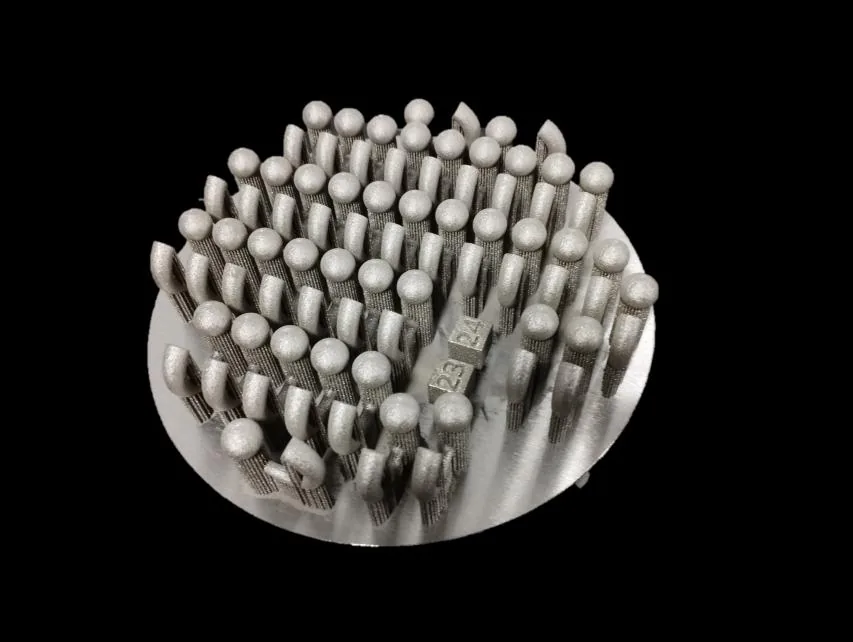
Printing platform filled with numbered test specimens manufactured in the same build
Print volume optimization Nesting How many parts fit in a single assembly. The cost per part is not determined by the machine: it's determined by how much build plate each part occupies.

If you have a file, the quote tool gives you a cost estimate in minutes.

11 Guarantees

A machine is bought for ten years, not for one campaign.

Investing in industrial equipment of this size always raises the same legitimate question: Will you still be around in five years, and will I still be able to produce with this machine? These are our answers, backed by facts.

Certification

CE · ATEX

CE certified machine compliant with European Directive 2006/42/EC and ATEX certified for potentially explosive atmospheres. The Garbi screening machine is also ATEX certified, with inerting for titanium and aluminium.

Independence

Without ties

Proprietary software, compiled and encrypted, royalty-free, and with unlimited licenses. Open configuration: you choose your powder supplier and keep your own material parameter sets. And it works offline.

Industrial support

ONA Electroerosion

Our industrial partner has been manufacturing machine tools for over 65 years and is a world leader in electrical discharge machining (EDM). They contribute production capacity, quality control, and a sales and technical service network.

Trust

Repeat customers

Several customers have bought a second machine after working with the first one for a year. In capital goods, that's the only sign of satisfaction that can't be faked, and it's what we look for.

Medium

Talk to the person who built it.

There is no call center. Whoever handles an issue has either written the firmware or assembled the machine. We handle installation, training, maintenance, and process development.

Ecosystem

The entire process

Machinery, software, proprietary powders under the SamyPowder brand, screening machine, metal powder extraction system, PPE, and shot blasting station. No need to integrate five suppliers to start production.

Producing in
  • Spain
  • Portugal
  • France
  • Austria
  • Hungary
  • Italy
  • India
12 Path

Ten years building the same technology.

  1. 2016 Foundation It was born in the BIC Ezkerraldea business development center, in Barakaldo. Ekintzaile Program.
  2. 2017 First commercial prototype Presentation at ADDIT3D. First Spanish company to develop the complete LPBF technology.
  3. 2018 ALBA 300 beta · CE Certification ONA Electroerosión joins as an industrial partner. Bind 4.0 finalists.
  4. 2019 Industrial testing Pre-commercial sales and CDTI's NEOTEC program.
  5. 2021 Commercial launch of the ALBA 300 Presentation at EMO 2021 and relocation of headquarters to the Zamudio Technology Park.
  6. 2022 Internationalization CDTI MISSIONS program. Trade fairs in Milan, Lyon, Stuttgart and Madrid.
  7. 2023 ATEX Certification New materials: medical-grade aluminium and titanium. EMO Hannover with ONA EDM.
  8. 2024 ALBA 500 and Garbi screening machine Award for innovation in additive manufacturing and award for the most innovative startup at the BIENNIAL 2024.
  9. 2026 New offices in BIC Bizkaia Public-private program of the Ministry of Science and Innovation for product development.
13 Frequently Asked Questions

What they ask us before buying.

What exactly does "closed-loop control" mean in metal 3D printing?

Closed loop means that the machine measures what is happening, makes decisions, and corrects as it prints. Most LPBF machines operate in open loop: the slicer writes a file, the drivers execute it, and for twenty hours nothing is checked.

In our case, the measuring part is taken care of: a 2D build chamber takes an image of the powder bed after each coating, and the sensors read oxygen, pressure, temperatures, filter, and hopper level. Automatic correction is under development and is not a feature of the machine we are delivering today. We prefer to say this rather than subscribe to an industry promise.

It is important to distinguish between the three things: monitoring records data for later review; closed loop between layers corrects from one layer to the next; and in-layer correction, in real time on the fuser bath, is not currently offered by any commercial LPBF machine.

What materials can I print on an ALBA?

A316L stainless steel, C300 tool steel, Inconel IN718, AlSi10Mg aluminium, Ti6Al4V titanium, and cobalt chromium, including medical-grade aluminium and titanium.

Thanks to open parameterization, you can use powder from different manufacturers and develop your own material parameter sets, which are saved and belong to you. You are not tied to a single powder supplier.

What installation do I need to get a machine up and running?

Less than people expect. The ALBA 300 runs on 230V single-phase domestic current and consumes the equivalent of an electric iron while in operation. It requires a power supply or an argon or nitrogen cylinder to generate the inert atmosphere.

It measures 730 mm wide, so it fits through a standard doorway, and it's on wheels. It can be used in shop floors, laboratories, and even offices.

How long does it take to print a part?

It depends on the height, the solid volume and the material, not the width. Some real cases measured on our machines: a monolithic heat exchanger in AlSi10Mg, 125 × 90 × 75 mm and 320 g, twenty hours on an ALBA 300. An axial turbine wheel, 240 × 240 × 100 mm and 740 g, twenty-eight hours on an ALBA 500. A stainless steel transmission housing of 4.5 kg, one hundred hours.

On the same reference, the ALBA 500 turns out 77 % more parts per hour than the ALBA 300: more power and a larger build plate.

How does LPBF differ from other metal additive manufacturing technologies?

Laser Powder Bed Fusion (LPBF, also called SLM) selectively melts very thin layers of metal powder, from 20 to 100 microns, with a laser inside a chamber with an inert atmosphere.

Compared to DED or WAAM, which add material with wire or projected powder, LPBF offers much higher resolution and densities, and allows for internal geometries impossible to machine, such as conformal cooling channels. In return, the parts are smaller and the process is slower.

What happens if the machine fails while under warranty or outside of it?

It's handled by the person who built it. There's no call center or escalation to a third party: the person who answers wrote the firmware or assembled the equipment.

Furthermore, our industrial partner ONA Electroerosión provides a well-established sales and technical service network for machine tools.

Can I test the technology on one of my own parts before deciding?

Yes, and that's what we recommend. You send us the geometry or bring it to our headquarters, our engineers analyze the manufacturability—orientation, supports, overhangs, and risk of re-heightening—we print it on an ALBA machine at no extra cost, and you take the part home.

It's the only honest way to answer the question that really matters, which isn't whether the technology works, but whether it works for your part.

Open days

Bring us your part. Go home with a printed copy.

The hard question with metal additive manufacturing isn't whether the technology works. It's whether it works for your part. So don't just take our word for it: bring the geometry.

Request your session
  1. You send us the geometry, or you bring it with you.
  2. Our engineers analyze manufacturability, orientation, and supports.
  3. We printed it on an ALBA card, free of charge.
  4. You take the part and decide for yourself
Industrial partnerONA Electroerosion — over 65 years manufacturing machine tools, industrial partner of Samylabs
AssociationMembers of ADDIMAT, the Spanish Association of Additive Manufacturing and 3D Technologies
AwardsAward for innovation in additive manufacturing and award for the most innovative startup, BIENNIAL 2024
PresenceSpain, Portugal, France, Austria, Hungary, Italy, India