

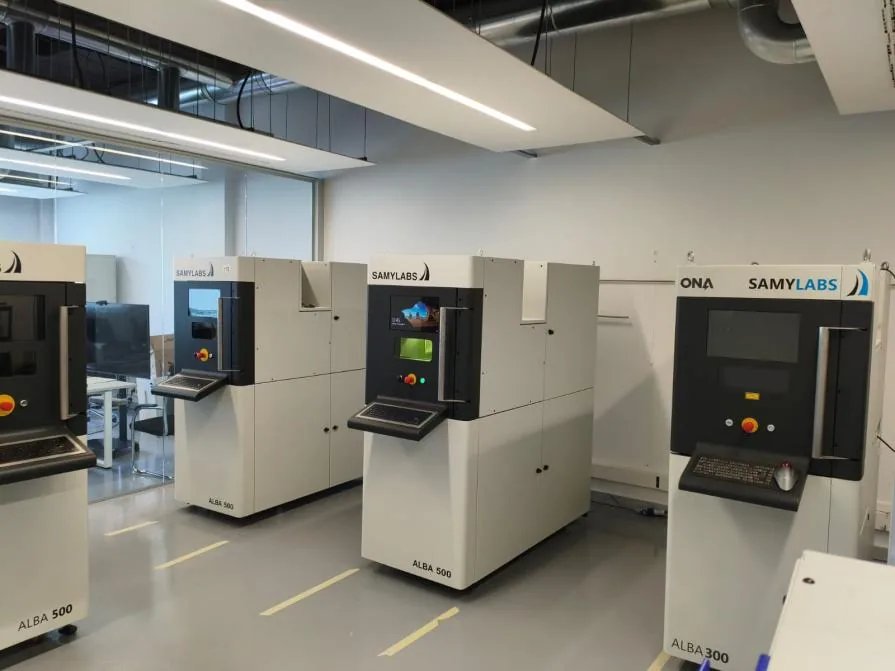
ALBA 500
Unlimited production
The industrial evolution of the ALBA 300. It multiplies the build volume by 2.4, increases to 500 W of laser power and dispenses powder in both directions, so that the laser also works on the return path.

Full technical specifications.
None of this is in an image or a PDF. It's in HTML, so you can copy, compare, and paste it into your report.
Full technical specifications 13 specifications in HTML, so you can copy and compare them · (*) Spot diameter configurable on request View specifications
| Laser power | 500 W |
| Wavelength | 1080 nm |
| Print volume | 250 × 250 × 300 mm |
| Layer thickness | 20–100 µm |
| Spot diameter | ≈ 75 µm * |
| Scan speed | 2 m/s |
| Filtration unit | Double and continuous: the filter is changed without stopping printing. |
| Hopper | Outside the build chamber, for faster cleaning |
| Shielding gas | Argon or nitrogen |
| Oxygen in chamber | < 500 ppm |
| Power supply | 230 V · 50–60 Hz · 2.7 kW |
| Dimensions | 745 × 1950 × 1940 mm |
| Equipment weight | 800 kg |
| Software | SamyStudio, slicing and control integrated into the machine |
| Certifications | CE and ATEX |
| Manufacturing | Spain |
Open parameterization: you can use powder from different manufacturers, develop your own material parameter sets, and take them with you. The alloys in the catalogue are machine-processed, which is not the same as having a closed, guaranteed set of parameters for any geometry: that's adjusted for each application.
Does it fit?
The three dimensioned views of the ALBA 500. Compare them with those of the 300: it's not the same stretched casing, it's a different machine.

- Width
- 745 mm It continues to pass through a standard 800 mm door, with 500 W inside.
- Depth
- 1950 mm 400 mm deeper than the ALBA 300. What you see in the plan confirms what the data sheet says: they are two different casings, not one stretched out.
- High
- 1940 mm Nine centimeters taller than the 300. It still fits in a 2.5m ceiling.
- Equipment weight
- 800 kg Wheels for moving it and adjustable feet for leveling it, just like the 300.
The plan and the table match perfectly. And the weight is not a typo either: Samylabs confirms that both ALBA models weigh 800 kg despite the size difference.
What is needed to install it?
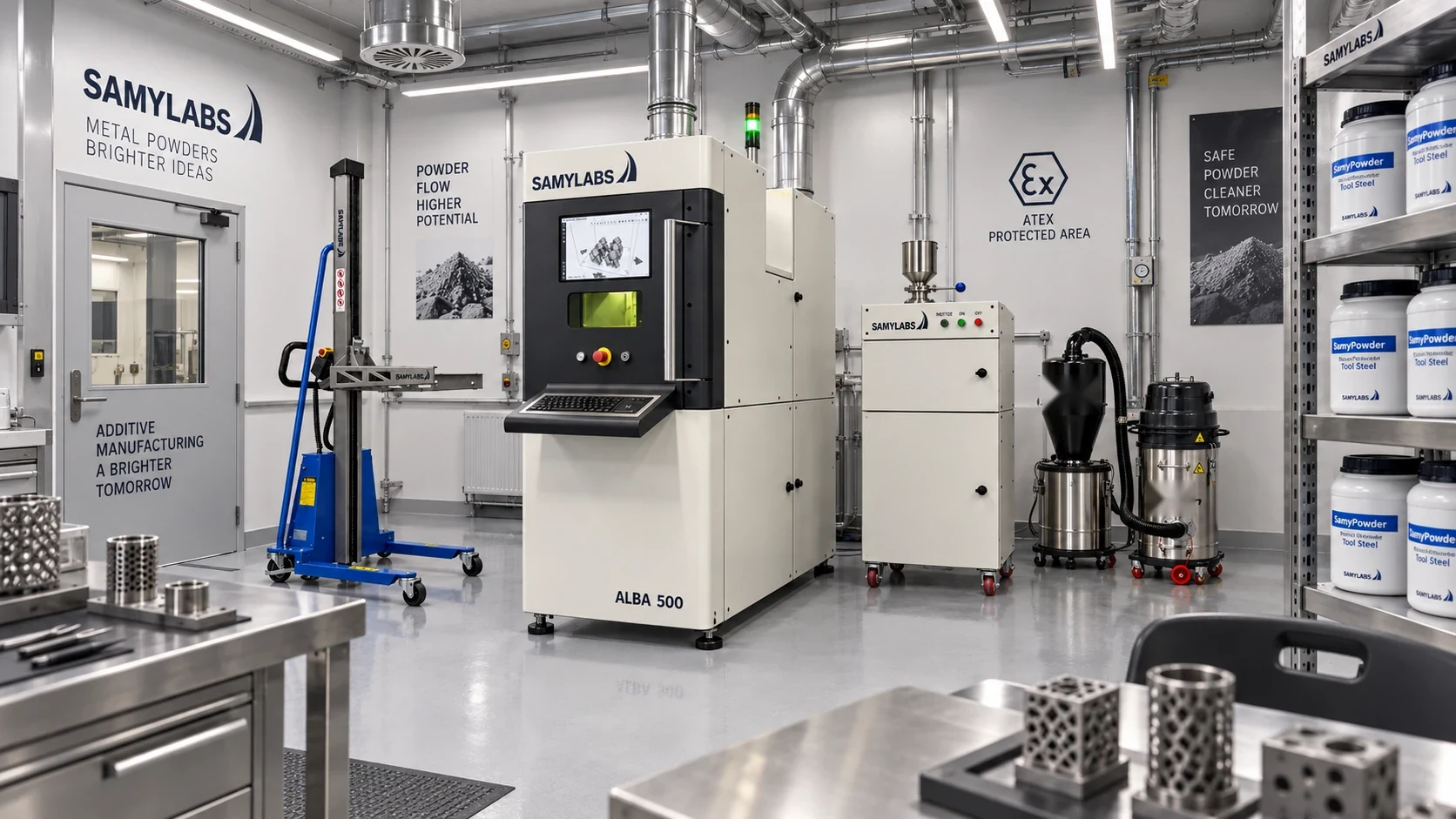
Half of the projects that get delayed aren't delayed by the machine: they're delayed by the meeting room. Here's the list, so you have it sorted out before signing, not after.
-
01
It fits through the door
745 mm front
It fits through a standard 800mm doorway. Measure the entire path, not just the front door: corridors, turns, elevator, and headroom. Discovering this on delivery day means a crane.
-
02
Current
230 V single-phase · 50–60 Hz · 2.7 kW
It plugs in: no three-phase power or electrical work required. What you do need to check is that the electrical panel can handle the combined load of the machine, the post-processing oven, the compressor, and the air conditioning.
-
03
Inert gas
Argon or nitrogen
Bottle, battery with ramp, or tank, depending on consumption. And one thing that's always forgotten: argon displaces oxygen, so the room needs ventilation and, depending on the installation and local regulations, oxygen detection.
-
04
Soil and site
800 kg on 745 mm × 1950 mm
Level, with load capacity and no vibrations nearby—not from a press, an overhead crane, or a forklift unloading. And space all around, not just underneath: it needs to be possible to open it, remove the tank, change filters, and allow the technician to enter.
-
05
The powder zone
A separate surface
Load, unload, sieve, and store, using dedicated vacuuming—not a shop floor vacuum—and in a closed, dry, and labeled storage area. With titanium or aluminium, all of this falls under ATEX regulations.
-
06
Filters and residue
A site and a procedure
The process generates metallic fumes and condensates that remain in the filters. It's essential to have a place to change them and a designated disposal site for the residue, which, with reactive alloys, is hazardous waste.
-
07
Atmosphere
Stable temperature and humidity
cleanroom isn't necessary; what's needed is to prevent grinding powder from falling into the vat. Humidity spoils the powder, and spoiled powder spoils the workpieces. And the machine heats up the room: if the shop floor is already struggling in the summer, expect that.
-
08
What's not on anyone's list
Post-processing and people
A single LPBF machine doesn't deliver parts: it requires a stress-relieving furnace, a cutting tool to separate the machine from the platform, a bench for removing supports, and access to machining equipment. And someone responsible for the machine, trained, preferably two.
This is the short version. The long version, with the nine questions to take to the maintenance meeting, is in what's needed in your shop floor. And if you'd prefer to review it with someone who has done the installation before, write to us.
The machine, in its place.
How it is installed and what is inside the build chamber.
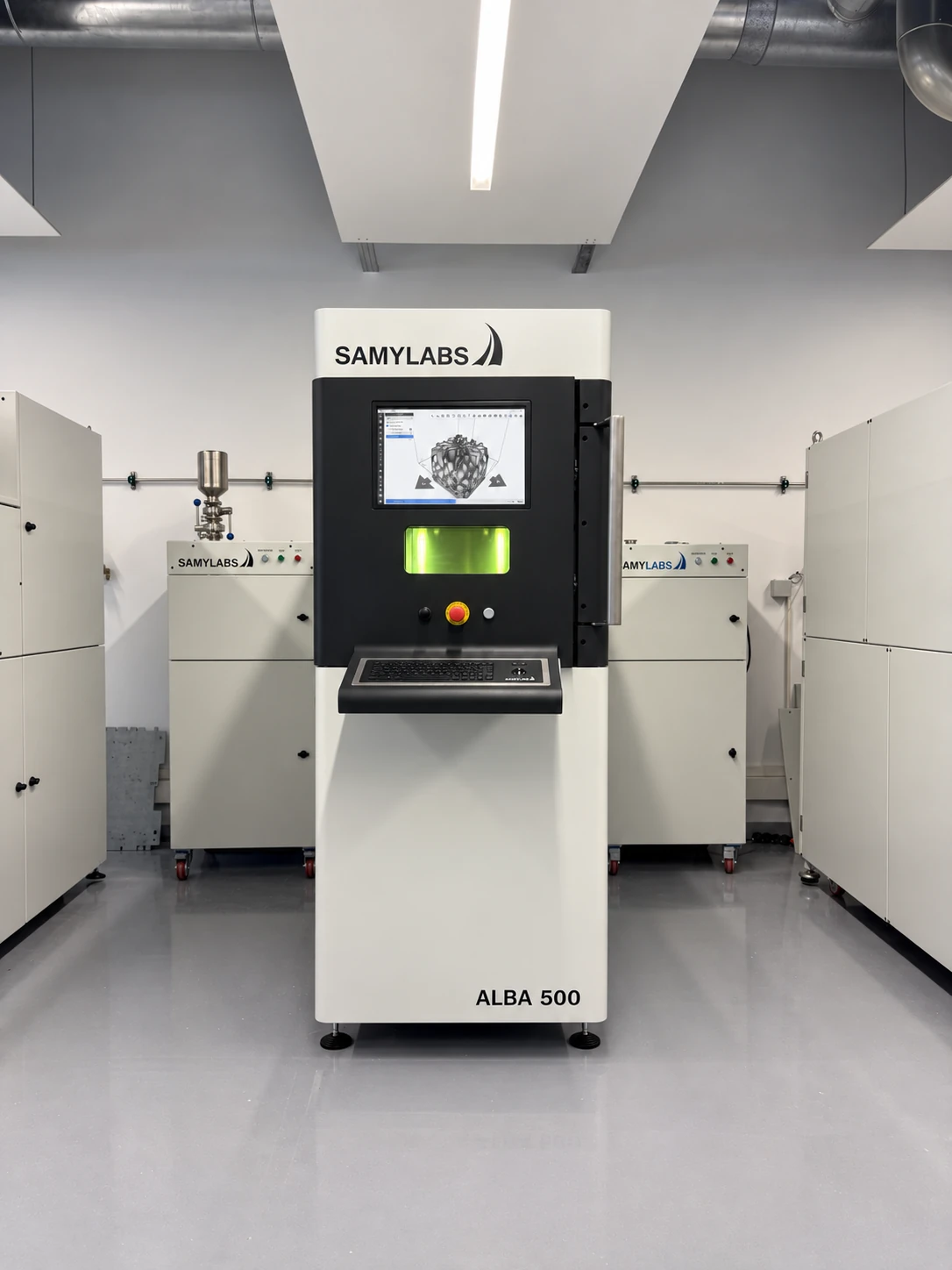
What lies behind the metal sheets.
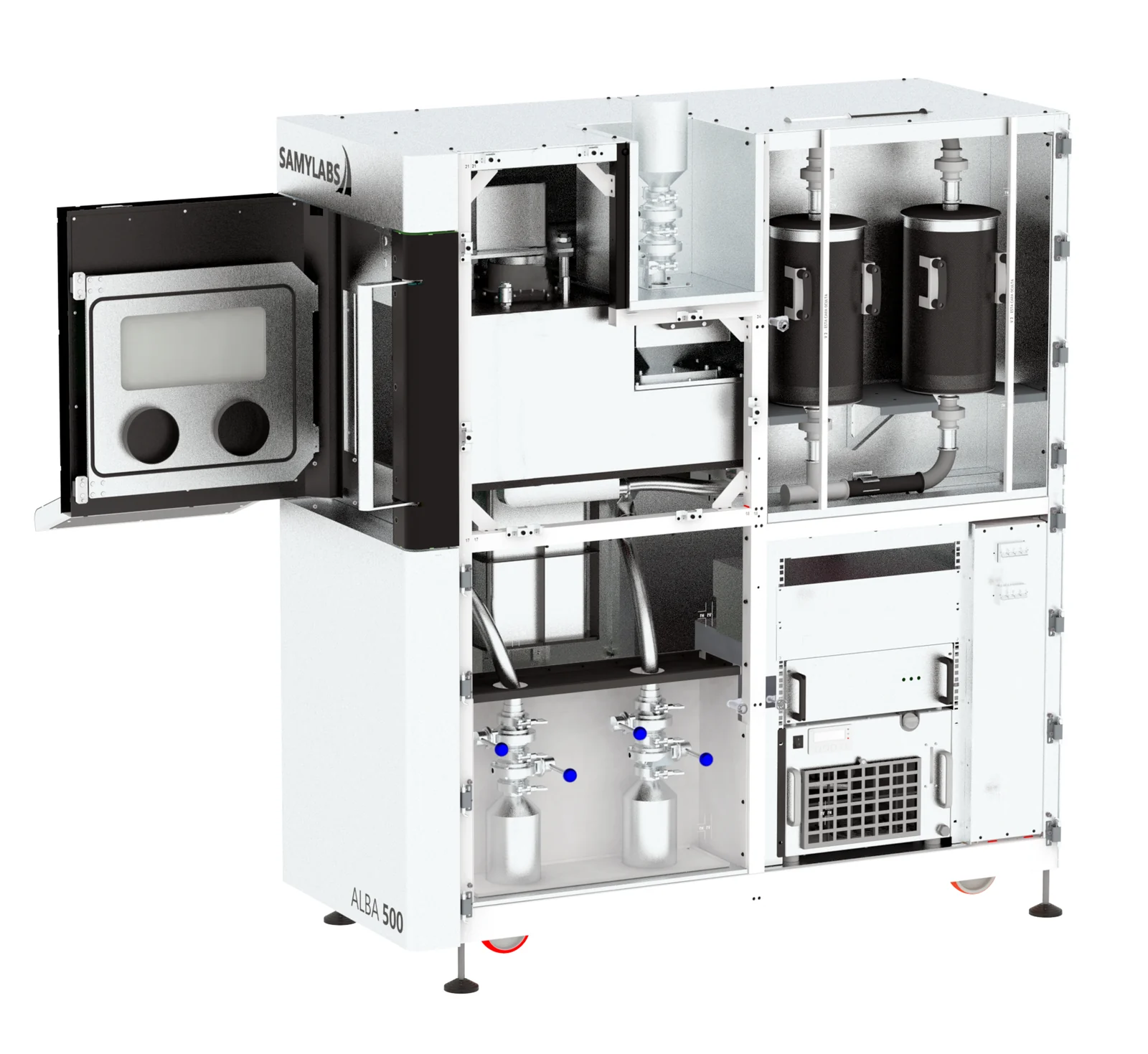
The same machine with the sides removed. At the top left, the manufacturing chamber with its door open and the two gloves; this is where work is done without opening the circuit. Above it, the powder hopper and its dosing system. To the right, the two high-capacity filters that remove fumes and metallic condensate from the process gas: these are what allow long, continuous build runs. Below, the valves and containers where the removed powder is collected. And in the cabinet on the right, the control and cooling systems.
Classified inside, zone by zone.
The cutout doesn't color-code circuits: it colors ATEX zones. Orange indicates Zone 21, green Zone 22. And it also reveals what truly distinguishes this machine from the 300.

- In orange · Zone 21
- Hopper and collection bins Zone 21 is the area where an explosive powder atmosphere may occasionally form during normal operation. It encompasses the two points where powder is handled: the entry point at the top and the point where excess powder falls below.
- In green · Zone 22
- Build chamber, gas circuit and filters Zone 22 is the area where poisoning is unlikely to occur under normal operating conditions and, if it does occur, it is short-lived. It is the volume that operates under a closed and inert atmosphere.
- The two green cylinders
- Double filter One part is changed without stopping the printing process. This allows for a thirty-hour build without opening anything along the way, and it's the real difference with the ALBA 300, which does require one part.
- Bottom right
- Laser cooling It goes inside the machine itself. In others, you have to reserve space next to it for a separate cabinet, and that changes the layout of the room.
This isn't an illustration: it's the volume classification required for a prevention plan. It's what allows you to choose the surrounding equipment and draft the explosion protection document without having to classify the machine yourself. What each zone means and what it requires is explained in ATEX and reactive powders. The same cut of the ALBA 300 uses only one filter instead of two.
The machine doesn't end with the casing.
The ALBA 500 shares the same control architecture and software as the 300: SamyStudio, written by us and running on the machine itself. A job prepared for one platform can be transferred to the other without changing the tool or parameter logic.
With a larger build volume, powder handling weighs more: the GARBI sieve lets you recover it in a closed circuit, inerted and without handling the material. The available alloys, in the materials catalogue.
The advantage of having developed the complete technology is precisely this: the parts fit together because they are from the same company.
The same part, both machines.
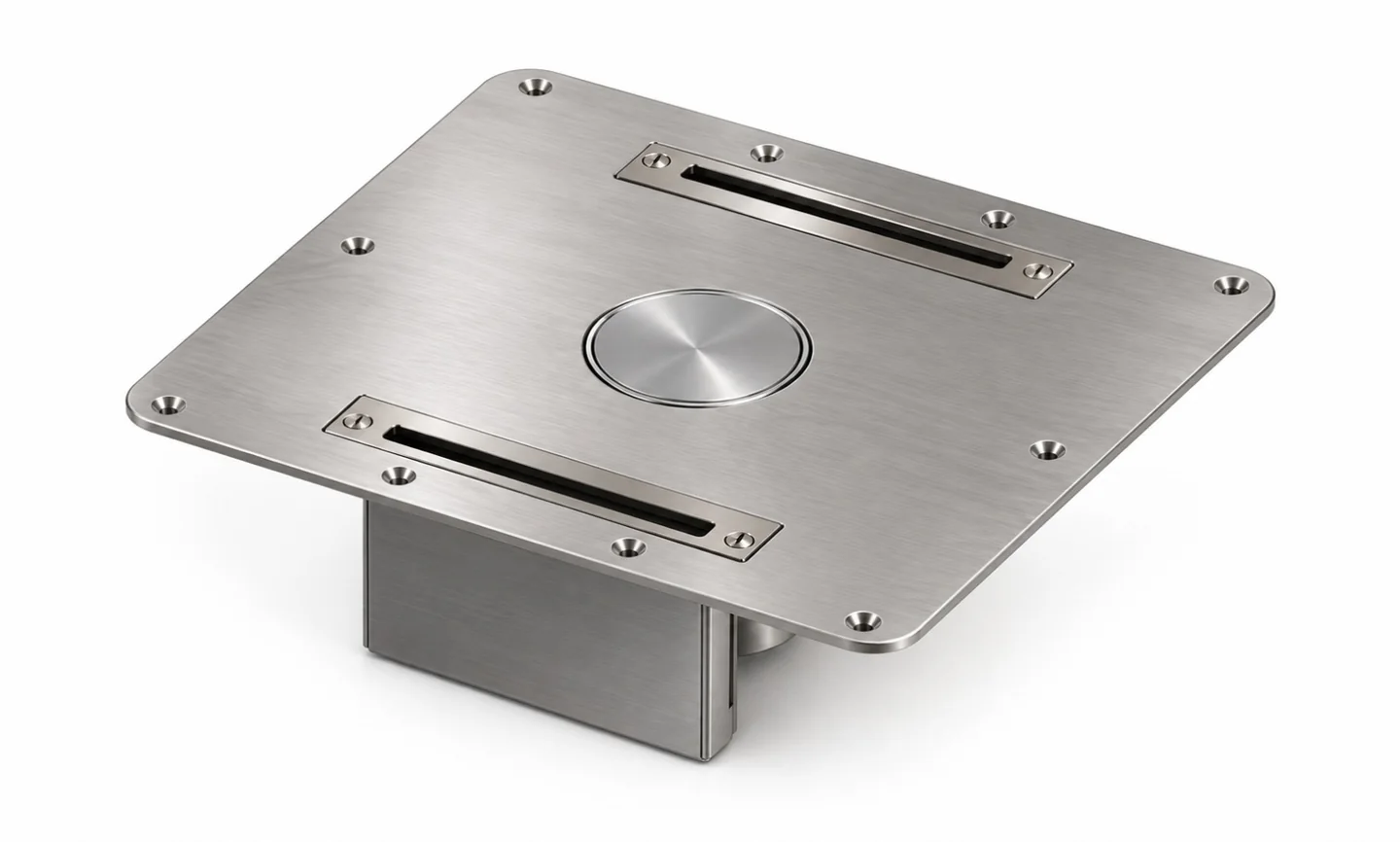
This isn't a catalog estimate: it's the same part number built into both machines. The photos are of those two build plates.
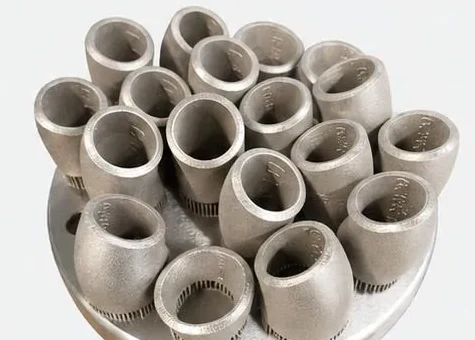
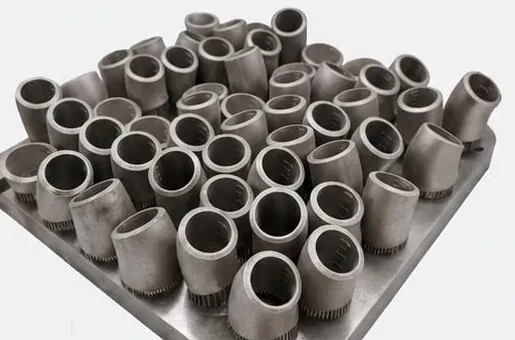
60% more parts per hour.
| ALBA 300 | ALBA 500 | |
|---|---|---|
| Print Volume | Ø200 × 250 mm | 250 × 250 × 300 mm |
| Parts per build | 18 | 54 |
| Total time | 22 h | 37 h |
| Time per part | 73 min | 41 min |
| Parts per hour | 0.8 | 1.5 |
The ALBA 500 doesn't work faster layer by layer; it simply fits more material on the build plate. That's why the entire assembly takes longer—37 hours compared to 22—yet each individual part comes out in just over half the time. This is the calculation that determines whether a machine will give you the production output you need, and it's the one you should do with your own part before making a choice.
The figures above come from that specific build, with that geometry. With another part they change: estimate it with yours.
Large parts in a single build.
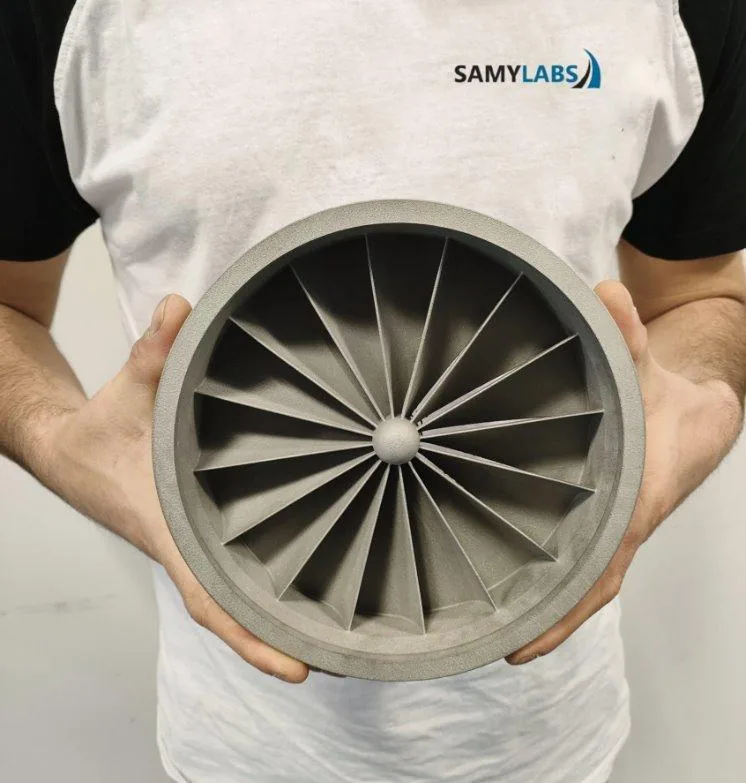
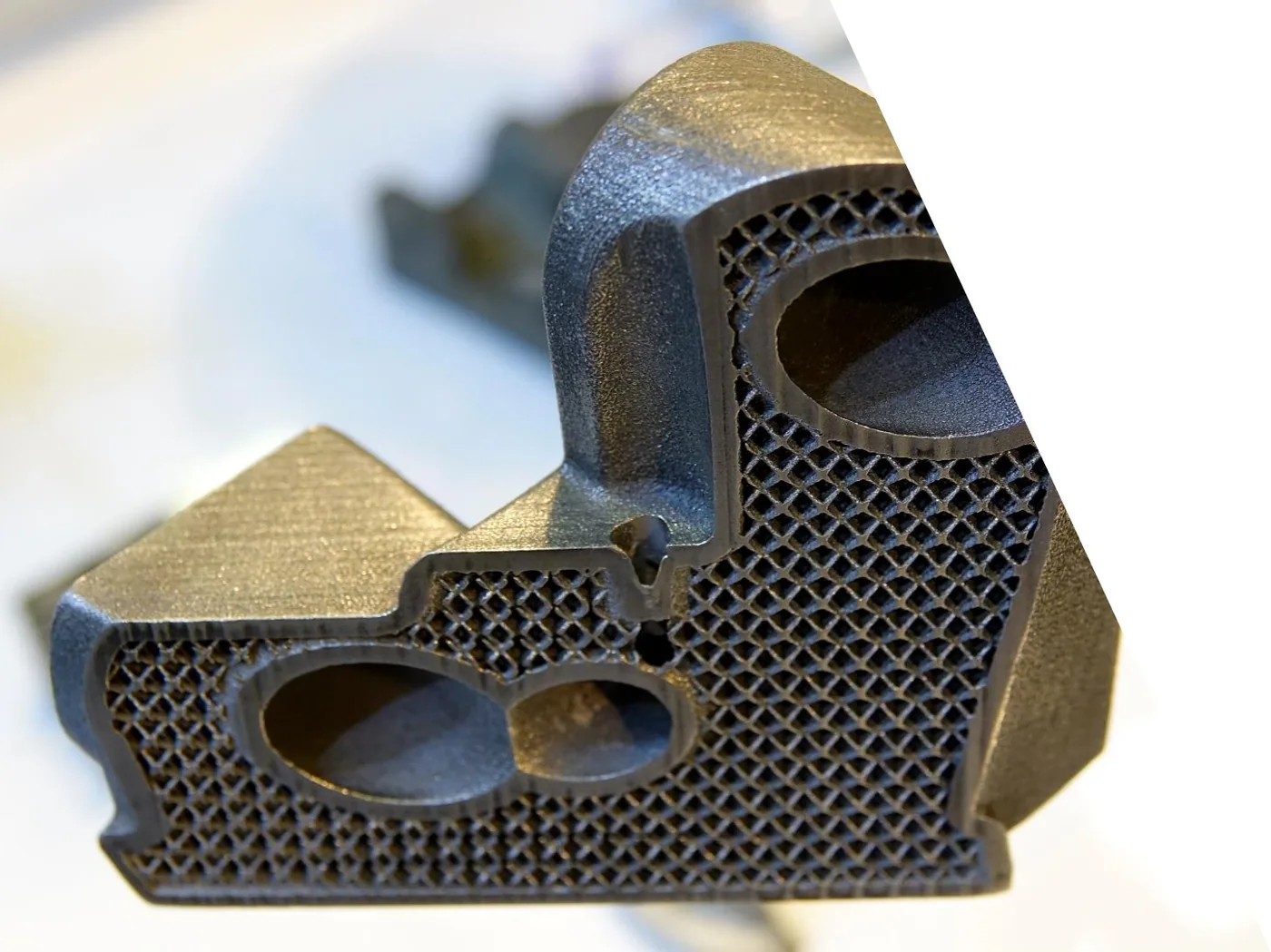
Bring us your part and we'll print it on an ALBA 500.
If you're considering moving into production, the question isn't how many watts the machine has. It's how many of your parts fit on a build plate and how long it takes. We calculate that using your geometry.
Request your session- You send us the geometry, or you bring it with you.
- We calculate how many parts fit per build plate and the time per part.
- We print it free of charge
- You get the part, the analysis, and the numbers
Before you decide
That's what everyone wonders when they see this machine.
- Technology One laser or several: what are the advantages and disadvantages of a multi-laser LPBF machine? When comparing two LPBF machines, the question arises: one with one laser or one with four? The marketing answer is…
- Product What do you need in your shop floor to install an LPBF machine? The conversation about buying a metalworking machine almost always revolves around the price of the equipment. And half of the…
- Business How much does it cost to maintain an LPBF machine per year: the complete breakdown The price of the machine is negotiated once. The cost of running it is paid every month for ten years,…
- Process How to qualify a part manufactured by LPBF (and why projects often fail there) Qualifying a part isn't about getting it right. It's about demonstrating that it will always work well, and being able…
- Technology What is a laser and why is the fiber laser the one that melts metal? laser is a device that emits light with three properties that ordinary light lacks: it is monochromatic (a single color,…
- Design Consolidating a set into a single part: the savings that almost no one talks about properly When people talk about the savings that additive manufacturing brings, they almost always talk about reducing material. And yet, in…