

It has passed the standard qualification part —density, dimensional and finish— and has signed the confidentiality agreement and the process conditions.
The company
A team that has built the entire technological chain.
Samylabs was founded in late 2016 in Bizkaia with a specific goal: to develop its own 3D metal printing technology using laser powder bed fusion. It is the first Spanish company to have done so entirely in-house.
Mechanical design, electrical design, laser control electronics, firmware, slicing software, and process technology. All developed in-house.
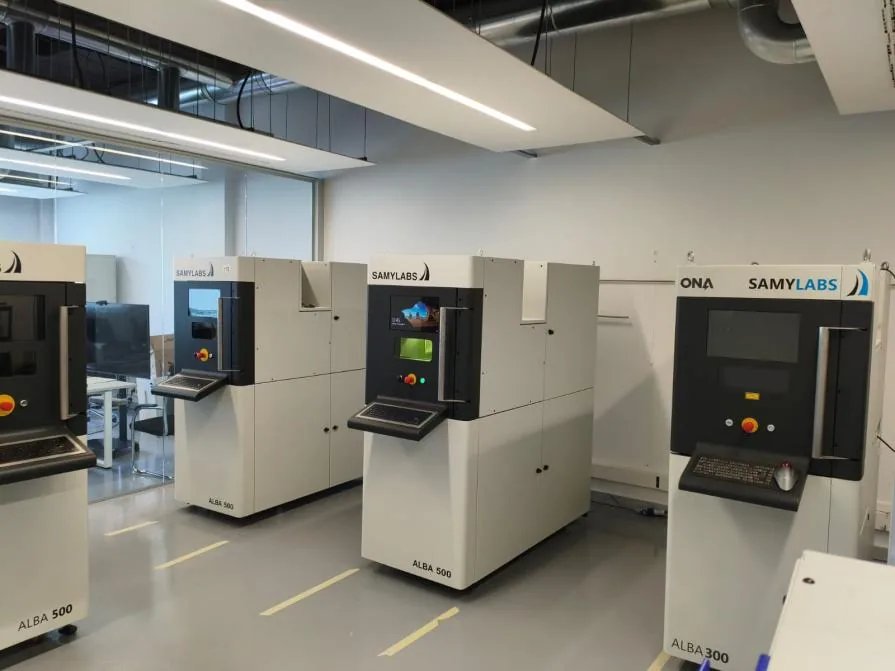
01 Who we are
An exception within the sector.
Around two thousand metal additive manufacturing machines are sold worldwide each year, distributed among nearly two hundred manufacturers. It's not a high-volume business: it's specialized machinery with long sales cycles, where depth of expertise is valued over breadth.
Most of these manufacturers are established industrial companies that integrate third-party technology: they buy the optics, controls, and slicing software and assemble them. Samylabs has developed everything in-house and has it in production for actual customers in seven countries.
What does that mean for the buyer?
When a single company controls the entire technology chain, three things happen that an integrator cannot offer.
Real Adaptation. If your application requires a different scanning strategy, a layer thickness not listed in the catalog, or a material that isn't on the list, it can be developed. There's no need to ask permission from a software vendor in another country.
No dependencies. The software is ours. It's compiled and encrypted, royalty-free, doesn't count license slots, and doesn't require an internet connection to run. The configuration is open: you choose the powder supplier, and the material parameter sets you develop are yours.
Support that understands the machine. Whoever picks up the phone has written the firmware or built the equipment. There is no call centre and no escalation to a third party.
Our mission
To become the partner of medium-sized, high value-added metal parts manufacturing companies for the provision of their 3D manufacturing systems.Samylabs' mission
And the way to achieve this is not to be like the big players, but to do well what they cannot do: adapt, explain ourselves precisely, and be close.
02 Path
Ten years building the same technology. And what comes next.
No changes of course, no pivots, and no reinventing ourselves every two years. The same technology, improved version after version.
- 2016 Foundation It was born at the BIC Ezkerraldea in Barakaldo, within the Ekintzaile program. First presence at the BIEMH.
- 2017 First commercial prototype Presentation at ADDIT3D. First Spanish company to develop complete LPBF technology. Finalists of the Bind 4.0 program.
- 2018 ALBA 300 beta · CE Certification ONA Electroerosión joins as an industrial partner. Open Maker program, part of the European H2020.
- 2019 Industrial testing Pre-commercial sales and CDTI's NEOTEC program.
- 2020 Sales scaling Product consolidation during the pandemic.
- 2021 Commercial launch of the ALBA 300 Presentation at EMO 2021 and relocation of headquarters to the Zamudio Technology Park.
- 2022 Internationalization CDTI MISSIONS program. Trade fairs in Milan, Lyon, Stuttgart and Madrid. In-house printing facility.
- 2023 ATEX Certification New materials: medical-grade aluminium and titanium. EMO Hannover in partnership with ONA EDM. EMAF in Portugal.
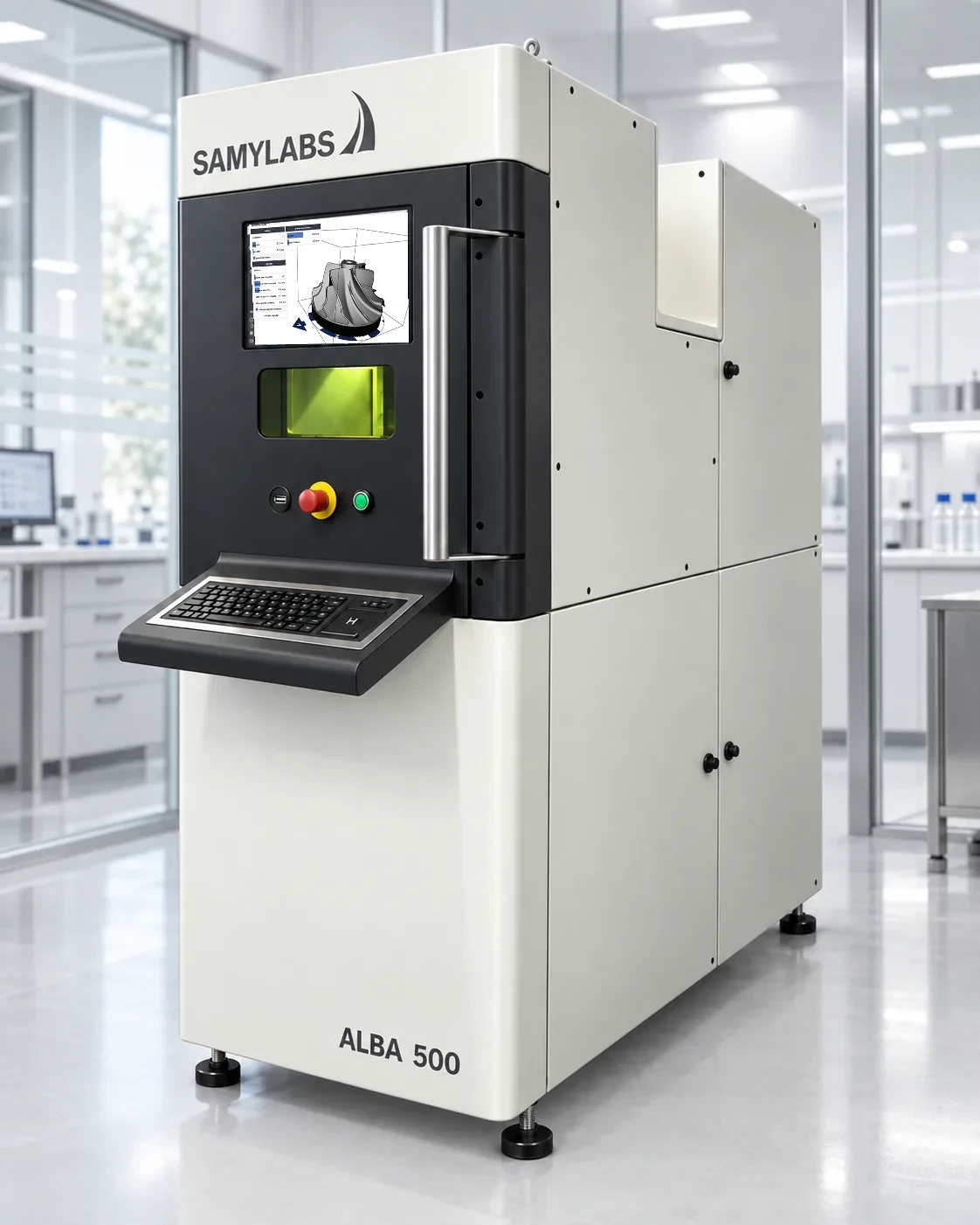
- 2024 ALBA 500 and Garbi screening machine Award for innovation in additive manufacturing and award for the most innovative startup at the BIENNIAL 2024.
- 2026 New offices in BIC Bizkaia Public-private program of the Ministry of Science and Innovation for product development.
- 2026 SamyQuote, the cost estimation engine The cost of an LPBF part, calculated using our process parameters and available on the market as a subscription service. In preparation.
- 2027 AdditiveDelivery, the manufacturing network On-demand manufacturing distributed among shop floors that already have an ALBA. The installed base becomes production capacity. In preparation.
- After The network opens Incorporation of machines from other brands into the network, after prior process qualification, and of the service as a distribution channel.
03 Where is it going?
Each machine sold improves the service. Each service sold sells more machines.
For ten years this has been a company that sells machines. From now on it's also a company that sells what comes out of them, and those two things don't compete: they push each other.
That's what changes the shape of the curve. Selling one more machine adds one unit; adding that machine to the network multiplies what the entire network can do.
2016
Foundation
2018
ALBA 300 beta
2021
ALBA 300 Launch
2024
ALBA 500 · Garbi
2026
SamyQuote
2027
AdditiveDelivery
2028
Open network
→
Distribution
The loop
Why this is a self-reinforcing cycle.
It's not a pretty introductory phrase: it's a chain of causes that can be traced with a finger, and each link is verifiable.
- 01 More machines installed Each ALBA sold is, in addition to a sale, a machine that can enter the network and contribute hours.
- 02 More network capacity With more machines and better geographical distribution, there are more slots, closer to the customer and with less waiting.
- 03 Better service and better price More capacity means shorter lead times and better use of build plates, which is where the real savings per part come from.
- 04 More customers are discovering LPBF The person who starts by ordering one part ends up ordering ten. And the person who orders a hundred a year does the math and buys the machine.
There's a fifth effect, not visible in the diagram, that could prove to be the most valuable: every price quote and every manufactured part tells us what geometries, materials, and volumes the market is truly demanding. That's product intelligence that no one else in the industry currently possesses, and it's becoming the next big thing.
The network is controlled
A network without quality control breaks down with the first collaborator who fails to deliver.
AdditiveDelivery's entire promise rests on one idea: the part comes out the same no matter where it's made. A single shop floor that lowers its standards ruins it, and the customer won't blame them, but us.
So the network operates like an industrial franchise: with written rules, scoring, and consequences. Each completed job is scored on four things: conforming parts, deadline met, quality of documentation, and response time.
Get inquiries faster, take on projects with tight deadlines, and access better rates. Rates are reviewed quarterly, either up or down.
It can sign process documentation and act as a demonstration and training center for its area. It is also responsible for auditing new entrants.
Stop accepting inquiries until the issue is resolved. It's not a punishment: it's what allows you to promise something to the customer and deliver on that promise.
Regarding opening the network to machines from other brands: it's the natural path to growth and to transforming this into a distribution channel, but it's also the only move capable of undermining the entire proposition. If they are allowed in, it must be with prior process qualification on a master part, with verified equivalent parameters, and always informing the customer which machine theirs is manufactured on. Opening it without this turns the network into a supplier directory, which is precisely what we want to avoid.
04 Who we work with
We didn't get here alone.
company that develops its own technology with a small team necessarily relies on an ecosystem. This is ours, with names and details.
Industrial partner
ONA Electroerosión has been our industrial partner since 2018. With over sixty-five years manufacturing machine tools and global leadership in electrical discharge machining, it contributes production capacity and quality control.
Sectoral association
We are partners of ADDIMAT, the Spanish Association of Additive Manufacturing and 3D Technologies, which represents the sector in Spain and is part of the AFM cluster.
Technology institutions and centers
- SPRIBasque Business Development Agency
- Provincial Council of BizkaiaInnovation and internationalization programs
- TecnaliaTechnology center
- BIC Bizkaia · BIC EzkerraldeaBusiness development centers
- CDTINEOTEC and MISSIONS programs
- Ministry of Science and InnovationPublic-private product development program
- Bind 4.0Industrial Acceleration Program
- Open MakerEuropean H2020 project
Project VIVALDI
Within the CDTI's MISIONES programme (file MIP-20211033), we work on the valorisation of ceramic and metal waste by generating powder for additive manufacturing. A consortium of six SMEs —Samylabs, Grupal Art, BCRicular, TMComas, Coldeed and BCN3D— with EURECAT, the CSIC through the ICV and the CENIM, and the CIM of the UPC as research centres.
05 Guarantees
What supports a small business.
When the manufacturer is a compact company, the question about continuity is legitimate and deserves an answer with facts, not adjectives.
CE · ATEX
CE certified machine in accordance with European Directive 2006/42/EC and ATEX for potentially explosive atmospheres, according to UNE, EN and ISO standards.
Without ties
Proprietary software with no royalties or license count, open parameterization for any powder provider, and operation without cloud dependency.
Repeat customers
Machines are producing in seven countries, and several customers have bought a second one after working with the first. It's the only sign of satisfaction that can't be faked.
BIENNIAL 2024
Award for innovation in additive manufacturing and 3D printing and award for the most innovative startup, for the advancement in product development, certification and industrialization.
The entire process
Machinery, software, proprietary powders under the SamyPowder brand, ATEX screening machine, metal powder extraction system, PPE, and shot blasting station. No need to integrate five suppliers to start production.
Machines installed in
- Spain
- Portugal
- France
- Austria
- Hungary
- Italy
- India
06 Where we work
Bizkaia, and it shows.
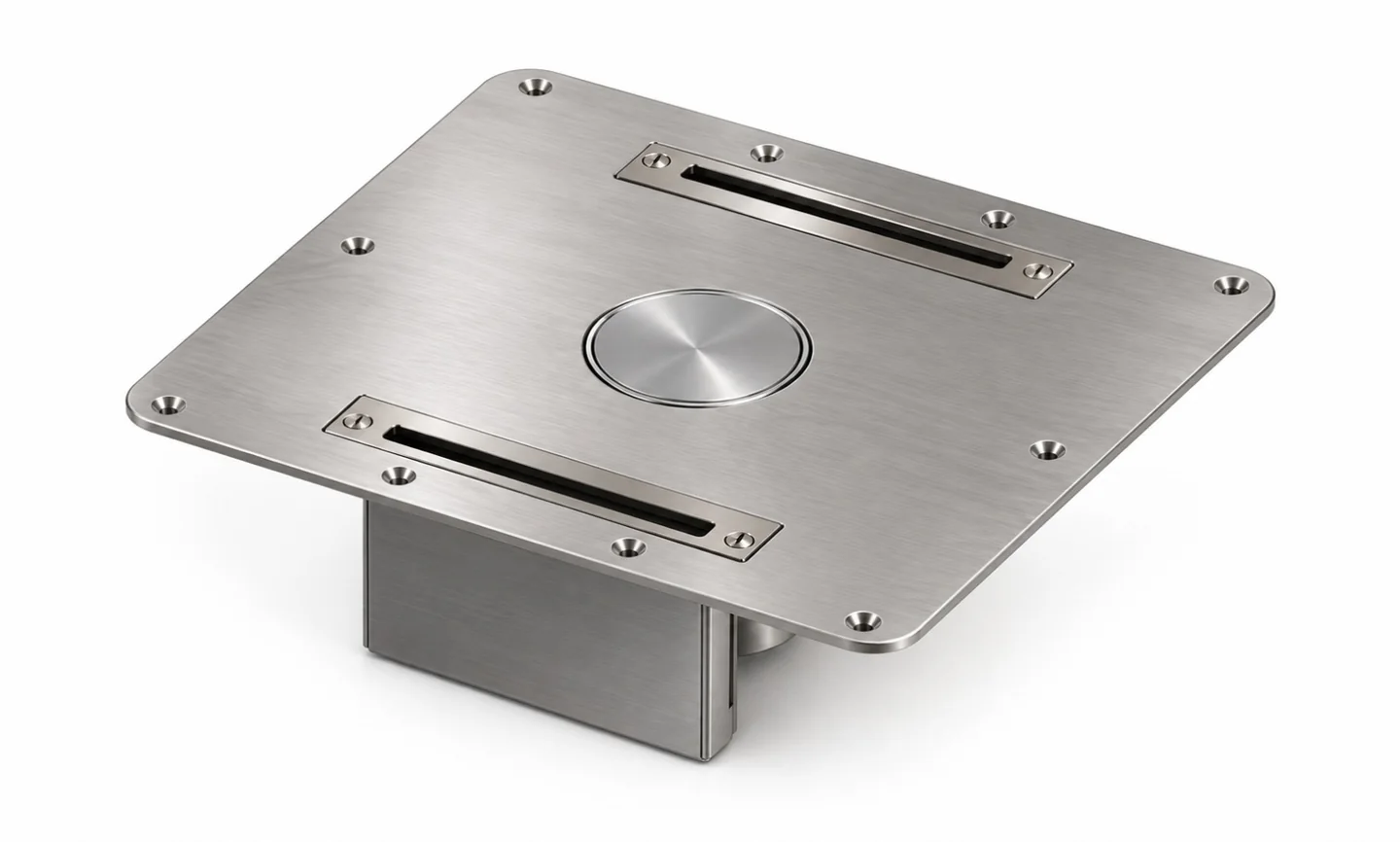
Here, each machine is designed, assembled, calibrated, and tested before leaving the factory. And this is where we invite you to bring your part.
Are you joining the printers' community?
Shop floors that manufacture using Samylabs machines, software and parameters, and that pass work among themselves when they don't arrive.
The door is open
The best way to get to know us is to come.
You don't need to buy anything or commit to anything. Bring in a part, see how we work, and decide for yourself if you trust these people.
Request your visit- Write to us and we'll find a date.
- We'll show you the machines at work.
- We analyze and print your part
- You get it, with the analysis
AddressAstondo Bidea, 612, 8 · 48160 Elexalde Derio (Bizkaia)
How to get thereFive minutes from Bilbao airport and fifteen from the city centre
Phone+34 946 859 923
Mailweb@samylabs.com
To learn more
Where do we come from?
What's behind manufacturing technology at home.
- Technology What does it mean to fully develop an LPBF technology (and why does almost no one do it) Samylabs was founded at the end of 2016 and is the first Spanish company to have developed entirely all the…
- Business Buying an LPBF machine manufactured in Europe: what really changes and what doesn’t "What difference does it make where it's manufactured, if the laser is the same?" It's a reasonable objection and deserves…
- Awards Two AFM Cluster awards at ADDIT3D 2024: what exactly do they recognize? At the ADDIT3D 2024 trade fair, held from June 3 to 7 at the Bilbao Exhibition Centre as part of…
- Materials Converting waste into metal powder: the project supported by the CDTI’s MISIONES program Powder is the consumable that determines whether an additive manufacturing plant is profitable. Within the CDTI's MISIONS program, we are…
- Sustainability Is 3D metal printing sustainable? The honest answer has two parts Let's start with the uncomfortable part, because otherwise, the rest is worthless. Melting metal with a laser, layer by layer,…
- Sustainability Manufacture the spare part here or bring it from far away: the full cost The argument is often told like this: manufacturing a spare part locally instead of bringing it from the other side…
- Trade fairs Formnext 2026: Where to find us in Frankfurt We will be at Formnext 2026, from November 17th to 20th in Frankfurt, within the ADDIMAT pavilion: Hall 12.0, stand…