

Many alloys, and the machine doesn't tie you to any of them.
Stainless steel, tool steel, nickel, titanium, aluminium, cobalt, chromium, and copper. All produced by inert gas atomization, with the sphericity and particle size required for powder bed laser melting.
And one decision that comes before the list: the parameterization of ALBA machines is open. You can work with our powder or with that of another supplier, and develop your own parameters. A captive consumable makes the customer a hostage.
The catalog, in text and not in an image.
| Alloy | Family | Why Choose It | Where It's Used |
|---|---|---|---|
| 316L | Austenitic Stainless Steel | Good corrosion resistance and excellent laser weldability. It is the alloy with the widest processing window and the most forgiving to start with. | General industry, chemical and food processing, tooling, functional prototypes |
| C300 (C300 · C300) | Maraging Tool Steel | Hardens by aging at low temperatures, with minimal deformation. It achieves high hardness after manufacturing, not before. | Conformal cooled mold inserts, dies, forming tooling |
| Ni718 | Nickel superalloy | Maintains mechanical properties at high temperatures and resists aggressive environments. It is the workhorse of hot additive manufacturing. | Turbine, power, oil and gas, and aerospace components |
| Ti-6Al-4V | Titanium | Best strength-to-weight ratio in the catalog, and biocompatible. Requires a very clean atmosphere and ATEX-compliant powder handling. | Aeronautics, space, implants and prostheses, competition |
| AlSi10Mg | Aluminium | Lightweight and with very good thermal conductivity. The natural material for weight reduction and heat exchangers. | Automotive, heat sinks, lightweight structures, turbomachinery |
| CoCr | Cobalt chromium | Hardness, wear resistance, and biocompatibility. Difficult to machine, easy to fabricate in layers. | Dental, implants, wear components |
| GRCop-42 | Copper (Cu-Cr-Nb) | Very high thermal conductivity while maintaining hot strength. The latest addition to the catalog. | Combustion chambers, high-flow cooling, defense and energy |
All of them are produced by inert gas atomisation, which is what gives spherical particles and a narrow particle size distribution. Those two things decide whether the recoater spreads a uniform layer or leaves gaps, and therefore decide the final density of the part. And other alloys can be supplied on request, though without a ready-made parameter set: the catalogue is a starting point, not a limit.
What you won't read here
We don't publish a table of mechanical properties with two decimal places. The yield strength, elongation, and density of an actual part depend on the manufacturing orientation, sweep strategy, layer thickness, and subsequent heat treatment. Providing a random number without specifying the conditions under which it was obtained is marketing, not engineering.
If you need values for a specific application, ask us for the material data sheet and we will send it to you with the conditions under which it was measured.
Prices and formats? They're all on display at buy metal powder: the alloys with their approximate price per kilo, purchase by closed weight with its discount scale, and what each shipment contains.
The catalog at a glance.

How much does a kilo cost?
List price per kilo, excluding VAT and excluding carriage. The real price depends on the quantity: these figures are the starting reference and come down by volume, so for an order of several containers or of more than one alloy what counts is the quotation, not this table.
| Alloy | Designation | Minimum order | Base price per kilo |
|---|---|---|---|
| Stainless steel | A316L | 10 kg · multiples of 10 | €47.00 |
| Tool steel | Maraging C300 | 10 kg · multiples of 10 | €80.00 |
| Nickel-chromium | Ni718 | 10 kg · multiples of 10 | €95.00 |
| Aluminium | AlSi10Mg | 5 kg · multiples of 5 | €50.00 |
| Titanium grade 23 | Ti6Al4V ELI · 15–45 µm | 5 kg · multiples of 5 | €234.00 |
| Titanium grade 5 | Ti6Al4V · 15–45 µm | 5 kg · multiples of 5 | €234.00 |
| Cobalt-chromium | CoCr | 10 kg · multiples of 10 | €157.00 |
| Copper | GRCop-42 · Cu-Cr-Nb | 10 kg · multiples of 10 | €280.00 * |
The two titaniums cost the same because the price is set by the powder, not the grade: grade 23 is ELI, with reduced interstitials, the one used in implants; grade 5 is the structural one. You choose by application, not by price.
The format changes the price
Powder is sold by closed weight, not by container volume: 10 kg minimum, in multiples of 10 —20, 30, 40— with nothing in between. Aluminium and titanium, being reactive, ship in a smaller special container: 5 kg minimum, in multiples of 5. * GRCop-42 copper is produced in occasional runs through the year, so it is subject to availability: ask about lead time before counting on it.
Four questions and almost always only one alloy remains.
At what temperature does the part operate?
Above a sustained temperature of around 500 °C, the discussion narrows to Ni718. Below that, the whole range opens up. It's the question that eliminates the most candidates at once.
Does weight rule or resistance rule?
If weight is the primary concern and the budget allows, choose Ti-6Al-4V. If weight is the primary concern but not the budget, choose AlSi10Mg. If strength is the primary concern and the part is unlikely to explode, choose steel.
Does it touch the human body or does it touch wear and tear?
CoCr and Ti-6Al-4V are biocompatible. For pure wear without biological contact, tool steel is usually cheaper.
Does it need to dissipate heat?
AlSi10Mg is used for most applications. GRCop-42 is used when it also needs to withstand temperature and pressure, which is where aluminium fails.
The metal has to absorb the laser light.
An LPBF machine doesn't melt powder with ambient heat; it melts it with a laser of a specific wavelength. And each metal absorbs that wavelength very differently. Those that don't absorb it reflect it, and without absorption, there's no molten bath.
The ALBA laser is a fiber optic laser, between 1064 and 1080 nm: the marked band on the graph. That's where you need to look at each curve.
See the data as a table
| Wavelength | Steel | Iron | Molybdenum | Aluminium | Copper | Gold | Silver |
|---|---|---|---|---|---|---|---|
| 254 nm | · | · | · | 30 % | · | · | · |
| 323 nm | · | · | · | 8,6 % | · | · | · |
| 423 nm | · | · | · | 7,9 % | · | · | 15,1 % |
| 561 nm | · | · | · | · | 30 % | 10,5 % | 2,4 % |
| 715 nm | · | · | · | 8,3 % | 3,2 % | 4,2 % | 0,9 % |
| 953 nm | · | · | · | 9,7 % | 1,4 % | 1,1 % | 0,2 % |
| 1,24 µm | · | 28,1 % | · | 4,6 % | 1 % | 0,5 % | 0,2 % |
| 1,61 µm | · | 24,8 % | · | 3,1 % | 1 % | 0,5 % | 0,2 % |
| 2,1 µm | 27,4 % | · | · | · | 0,9 % | 0,5 % | 0,2 % |
| 2,74 µm | 23,9 % | 17,1 % | 5,2 % | 2 % | 0,8 % | 0,5 % | 0,2 % |
| 3,58 µm | 21,6 % | 14,3 % | 3,7 % | 1,9 % | 0,7 % | 0,5 % | 0,2 % |
| 4,64 µm | 19 % | 11,9 % | 3 % | 1,7 % | 0,7 % | 0,5 % | 0,2 % |
| 6,07 µm | 14,3 % | 8,8 % | 2,3 % | 1,5 % | 0,4 % | 0,5 % | 0,2 % |
| 8,17 µm | 10,9 % | 5,5 % | 1,8 % | 1,2 % | 0,4 % | 0,5 % | 0,2 % |
| 10,18 µm | 9,6 % | 4,7 % | 1,5 % | 1,1 % | 0,4 % | 0,5 % | 0,2 % |
| 13,41 µm | 9,1 % | 4,8 % | 1,4 % | 0,9 % | 0,3 % | 0,5 % | · |
- Our laser
- 1064-1080 nm Fiber laser. It is the marked strip on the graph, and it is the vertical line along which all curves must be cut.
- Steel, iron and molybdenum
- They absorb well In that band iron is around 30 % and steel goes off the top. That is why A316L, C300 and Ni718 are the comfortable materials for this machine: the physics is on your side.
- Aluminium
- Much less Around 6 % at that wavelength, several times less than steel. It works —AlSi10Mg is in the catalogue— but it asks for more power and finer parameters.
- Pure copper, gold, and silver
- Next to nothing Below 1% on polished surfaces: at 1080 nm the light turns against them. At 532 nm green, the same curve spikes, and that's why printing pure copper requires a different laser—and that requires a different machine, not different parameters.
- The GRCop-42 does fit.
- It's an alloy, not pure copper. Confirmed by Samylabs: it contains a portion of radiation-absorbing material and a high copper content, but it's not pure copper. That's why a copper alloy can penetrate where pure copper cannot.
The curve is plotted point by point from the reference sheet Samylabs gave us, and then checked against published industry values: at 1064–1080 nm, laser manufacturers' tables give around 32–35 % for steel and 8 % for aluminium, which is what comes out here. Two warnings, because they matter: the curves are for a polished surface and a powder bed absorbs considerably more —the light bounces several times between particles before it can escape—; and the sheet only reaches 30 %, so anything above that is not drawn. It is useful for grasping the order of magnitude and for knowing what to ask of a machine before buying it, not for calculating parameters: those for each alloy come out of the laboratory and live in SamyStudio.
How the powder arrives.
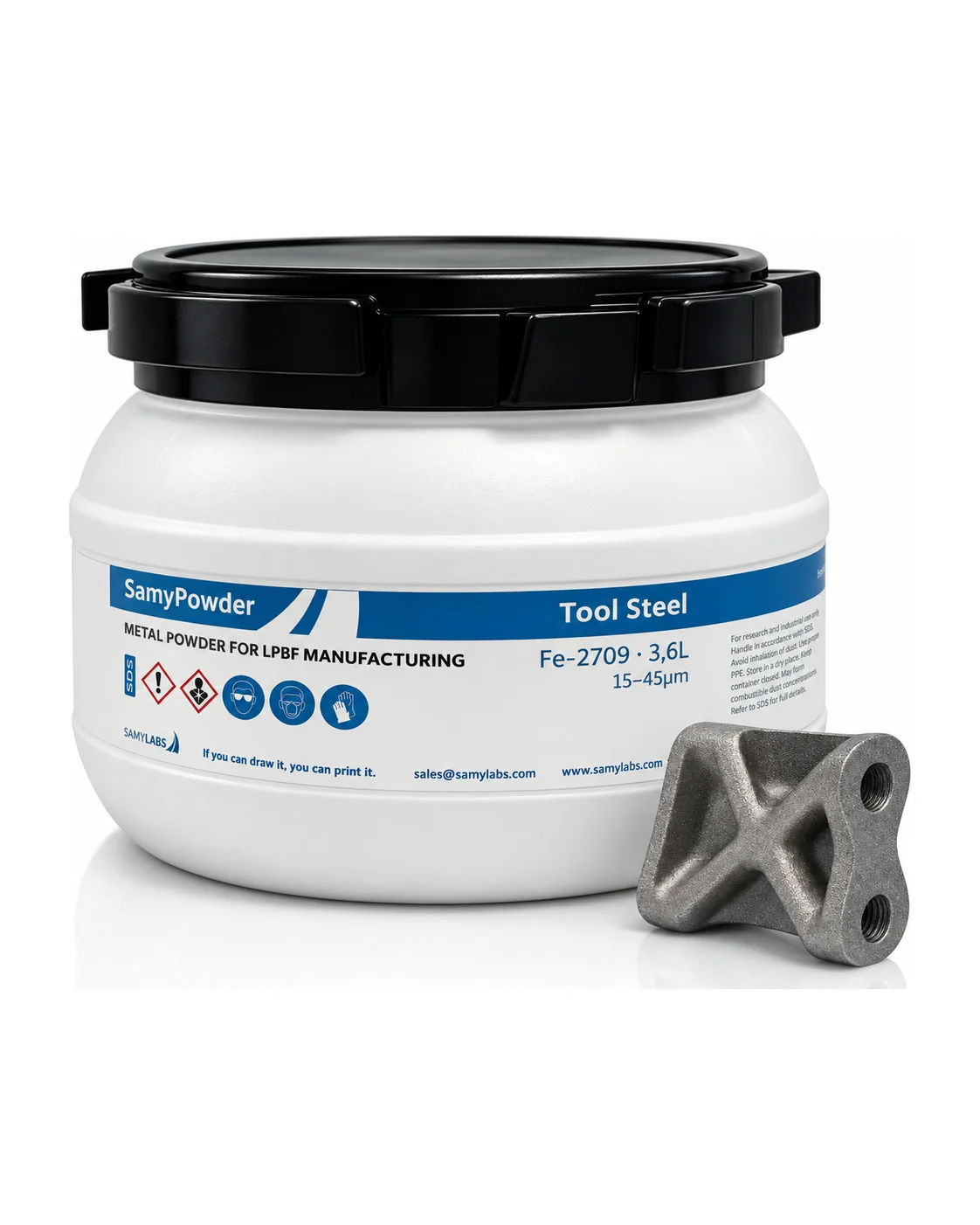
The container is labeled by alloy and batch, with the particle size printed on the label itself. Traceability starts here: without a batch number, there's no way to qualify anything afterward.
The machine does not force you to buy the powder from us.
SamyStudio allows you to adjust power, Scan speed, frequency, energy density, fill strategy and layer thickness, and save the result as your own exportable material parameter set.
This isn't a commercial concession: it's a necessary condition for qualifying material that wasn't on the list from day one. A manufacturer who bought their software from a third party typically can't unlock those parameters even if they wanted to.
To develop materials without wasting kilos of expensive powder, there is the SamyFlex, a reduced volume module that is installed inside the ALBA 500 chamber and allows the manufacture of test specimens with a fraction of the material.
And where will the powder come from tomorrow?
Within the CDTI's MISSIONS program, we are working on obtaining powder suitable for additive manufacturing from ceramic and metal waste. If the starting material is waste with management costs, both the price of the consumable and the environmental footprint of the process decrease.
The powder, with the parameter set already made.
Alloys with clearly displayed prices and certificates included with each batch. And the machine keeps running on powder from whomever you choose.
What you ask us about powder.
Can the leftover powder from a build be reused?
Is it dangerous to handle titanium or aluminium powder?
Can I use powder from another supplier?
How much powder do you need to get started?
About powder and alloys
What lies behind choosing one material over another.
- Materials 316L, Ni718 or Ti-6Al-4V: when to choose each one Three alloys cover the vast majority of laser powder bed fusion projects. They are not interchangeable, nor are they in…
- Materials What materials can be printed on metal? The honest list Laser powder bed fusion (LPBF) can, in practice, produce almost any weldable alloy. And that's the rule that best predicts…
- Materials How is metal powder manufactured and what types exist? Metal powder for additive manufacturing is produced by atomizing liquid metal: the alloy is melted and the jet is broken…
- Sustainability Excess powder: how much is reused, when it should be removed, and what is done with it In a laser powder bed fusion build, the laser melts only a small fraction of all the powder inside the…
- Materials SamyPowder: what’s behind a tin of metal powder SamyPowder is our catalog of metal powders for laser powder bed fusion: 316L, C300, Ni718, Ti-6Al-4V, AlSi10Mg, CoCr, and, starting…
- Process Argon or nitrogen: the gas that almost no one looks at when comparing LPBF machines Inside an LPBF machine, there's a molten metal bath at over 1,500 degrees Celsius moving at meters per second. If…